
A blind flange closes a pipe opening. It has no centre bore, so nothing passes through it. You bolt it onto a matching flange face to blank off a line end, a branch, or a spare nozzle that has to stay shut. It is a closing part, not a connecting part.
On a piping material take-off you will see it written as BL. On site you will also hear it called a blank flange, and some drawings still carry that name. The two names describe the same item: a flange with no bore, bolted up to shut a line instead of joining two runs of pipe.
We supply carbon steel blind flanges to ASME B16.5 in A105, and stainless steel where the medium calls for it.
How to identify a blind flange in your hand
Five checks, in the order that answers fastest.
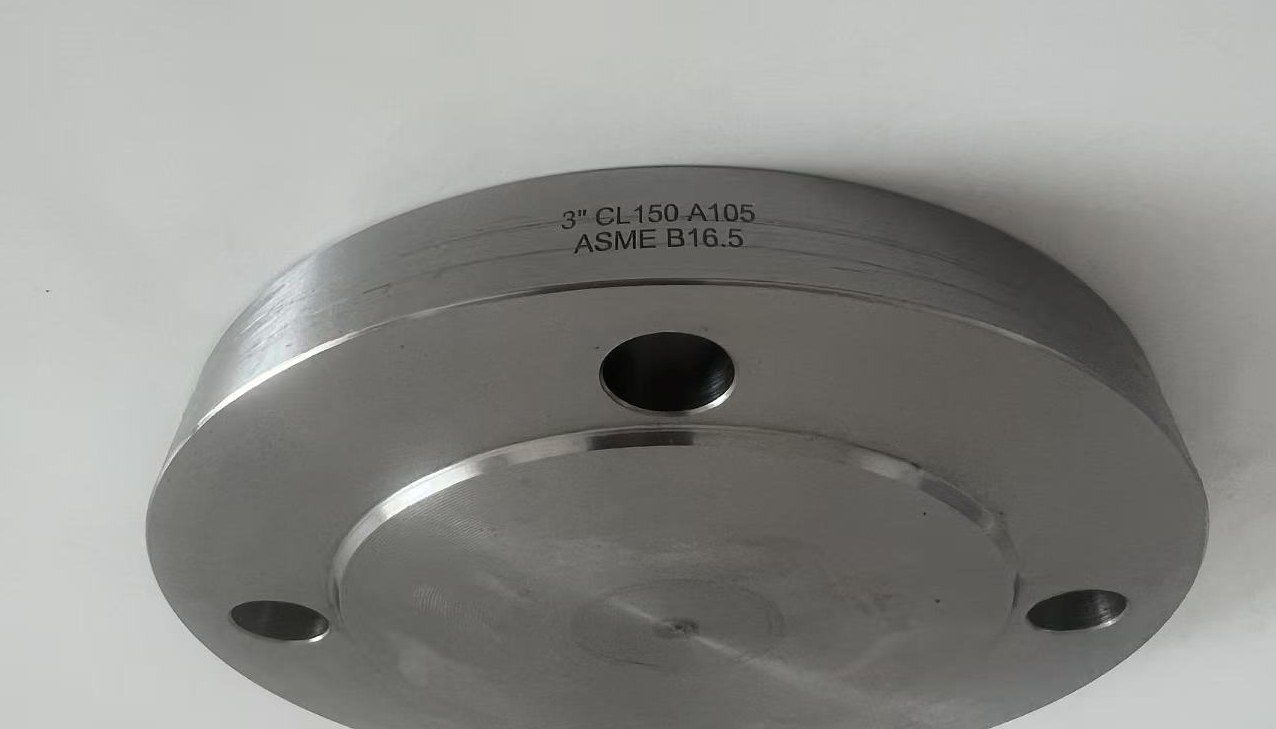
- Look at the centre. This is the fastest test. A blind flange is solid in the middle: no bore, no hole, no daylight. If you can look through the part, it is not a blind. It is a slip on, a weld neck, a threaded or a socket weld flange, or a plate that has already been drilled for a line.
- Read the stamping on the rim. Size, class, material and standard are marked there. On a blind, the stamping carries the whole description of the part, because there is no bore to measure.
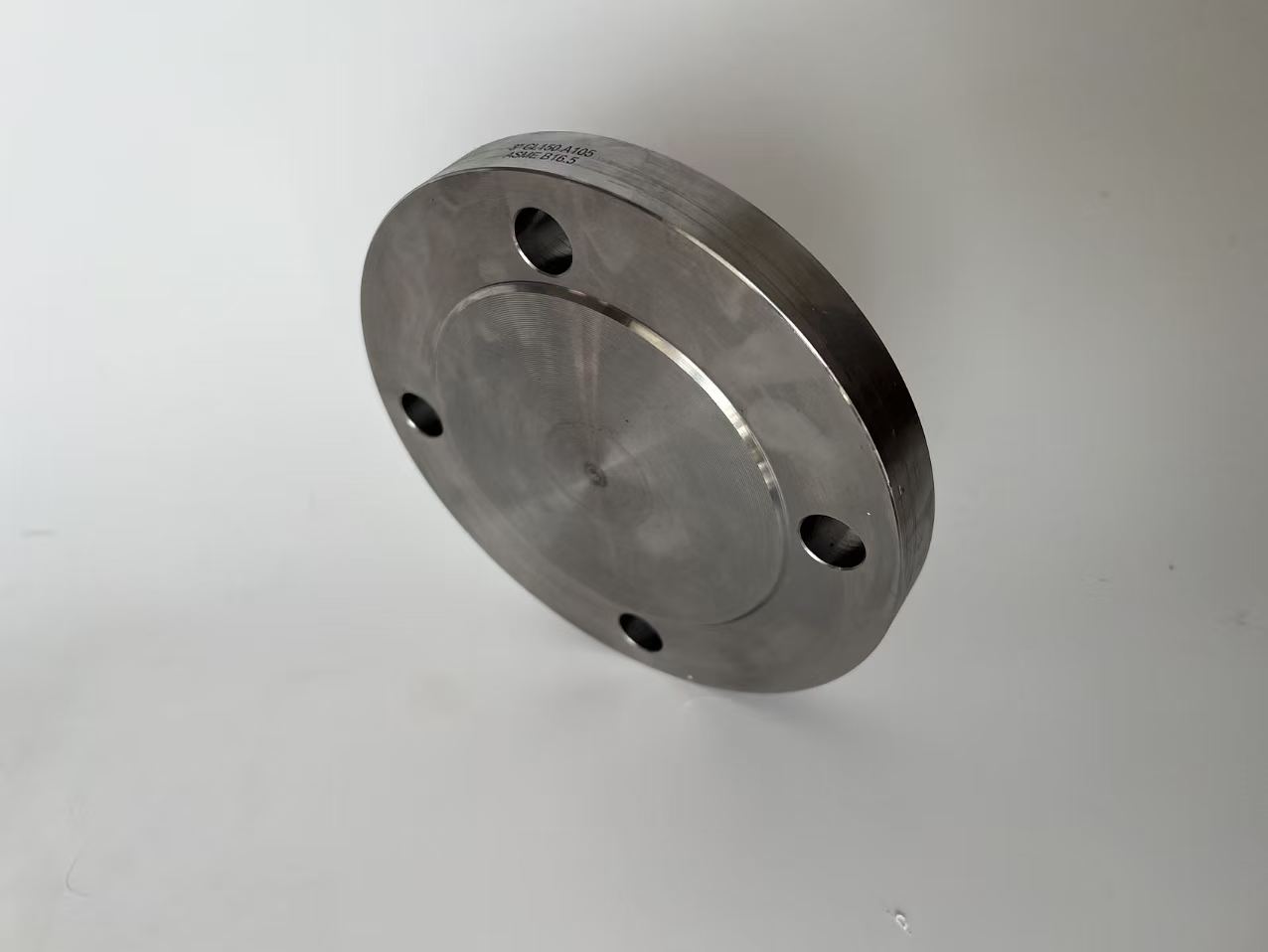
- Check the profile from the side. A blind is a flat disc of even thickness, with no hub and no neck. The bolt holes are drilled on a circle around the solid centre, and their number and spacing are fixed by the flange it mates with.
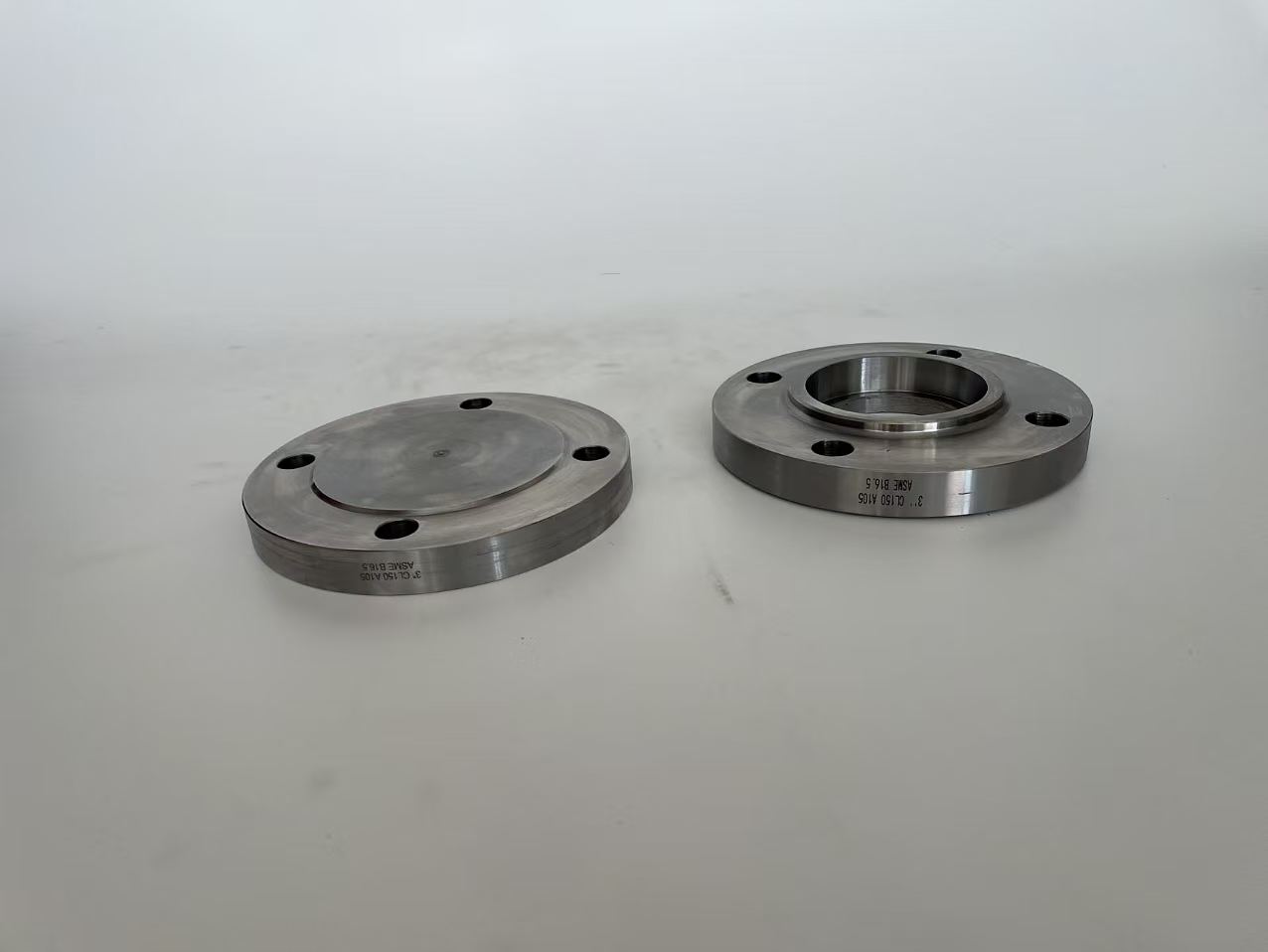
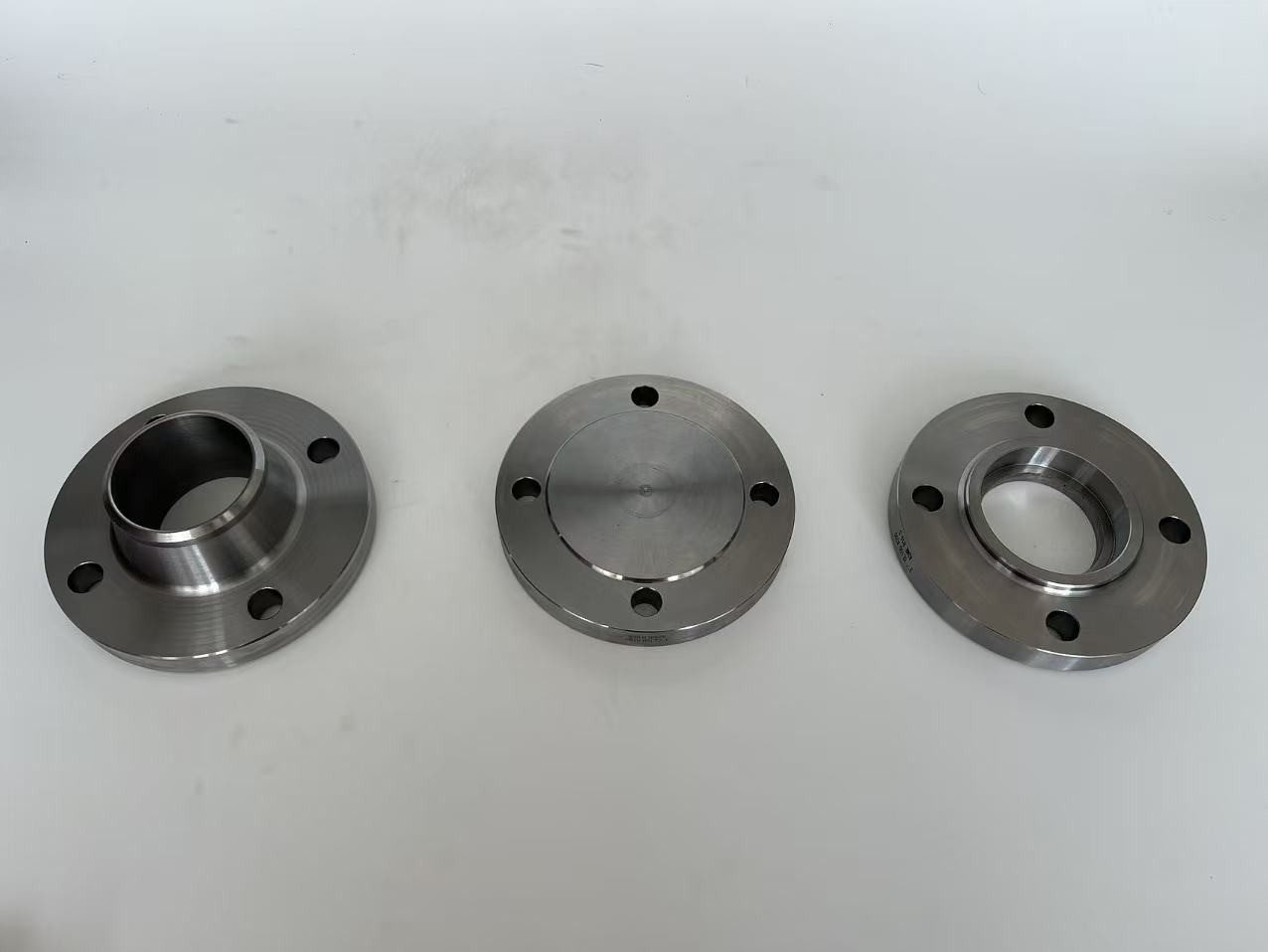
- Stand it beside a slip on or a weld neck of the same size. Same outside diameter, same bolt circle, same number of holes. The difference is the hole in the middle, and only one of them has it.
- Check how it mounts. A blind flange is never welded to the pipe. It is held by bolts, sandwiched between two flange faces with a gasket on the sealing face. A butt weld end is bevelled and a socket weld end is recessed; a blind has neither.
The four jobs a blind flange does
Blanking a line end. A line that stops and will not be extended again is closed with a blind. So is a spare nozzle on a header or vessel. The blind keeps the opening sealed and the line in service.
Isolation for maintenance. When a section is cut out of a live system, blinds go in at the boundary of the work. A closed valve can leak past its seat. A blind flange has no seat to leak through.
Hydrostatic testing. Test packs are built with the open ends blanked so the section can be filled and pressurised. Those blinds are working parts of the test and have to suit the test pressure and medium.
A connection held for later. Capacity that is planned but not built yet is left as a flanged nozzle with a blind on it. The line runs today, and the opening is there when the next phase needs it.
Materials and pressure class
A105 carbon steel is the everyday choice for oil, gas, water and steam lines. Stainless steel is specified where the medium or the site conditions call for corrosion resistance, and the grade follows the medium. Pressure class comes from the project design conditions, not from the size of the pipe. Blinds are normally supplied with a raised face (RF); a flat face (FF) version is ordered when the mating flange is flat faced. Wall thickness belongs to the pipe and the fittings, so on a blind flange the class designation is what you specify.
A blind has to sit on the same bolt circle as the carbon steel flanges, elbows and tees in that line.
Blind flange or spectacle blind?
They are two different parts, ordered separately. A blind flange is a single disc: bolt it on to close the line, unbolt it to open the line. A spectacle blind carries a solid disc and an open disc on one assembly, stays bolted to the line, and is rotated when the line has to be opened or closed. Single-disc blinds follow ASME B16.5, and that is the range we run.
When a blind flange is not the right answer
If the joint will be broken routinely, a blind is slow to work with. Match the closure to how often the line has to be opened.
If the end is permanent and there is no flange to bolt to, a welded cap is the part for that job.
The gasket and the bolts have to be part of the order. The gasket has to suit the face type and the medium, and the bolts are sized by the flange.
Plan the removal. A blind in a tight rack needs room for the bolts to come out and for the disc to be lifted clear, and a large blind is heavy.
What blind flanges are used for on Gulf projects
Around the Gulf the same pattern repeats: lines come out of service for maintenance, test packs are built and broken, and spare nozzles wait on headers for the next phase. High humidity and salt in the air age a plant faster, which means more inspection, more shutdowns and more isolation work. Every one of those jobs ends in a blind flange somewhere in the line. If you are checking a spool or a warehouse shelf and you are not sure what a part is, a photo of the face and the stamping usually settles it.
Most blinds are standard items, but custom sizes and special requirements work the same way: send the drawing or the stamping and we will confirm what matches before anything is made.
Blind flange questions
Is a blind flange the same as a blank flange?
Yes. Blank flange is the older, more general name for the same part: a flange with no bore that closes an opening. Blind flange is the term used in the ASME B16.5 listing.
Can a blind flange be welded to a pipe?
Normally no. A blind flange is bolted between flange faces, and it has neither a bevel nor a socket for welding. When an opening has to be closed by welding, the fitting used is a cap.
What is the difference between a blind flange and a spectacle blind?
A blind flange is a single disc you bolt on and take off. A spectacle blind carries a solid disc and an open disc on one assembly, and is rotated to switch the line between open and closed.
When should I use a blind flange instead of a cap?
Use a blind flange when the opening already has a flange to bolt to, or when it may have to be opened again later. A cap is welded on and is used for a permanent closure.