
Carbon Steel Lap Joint Flanges
 1 / 1
Description
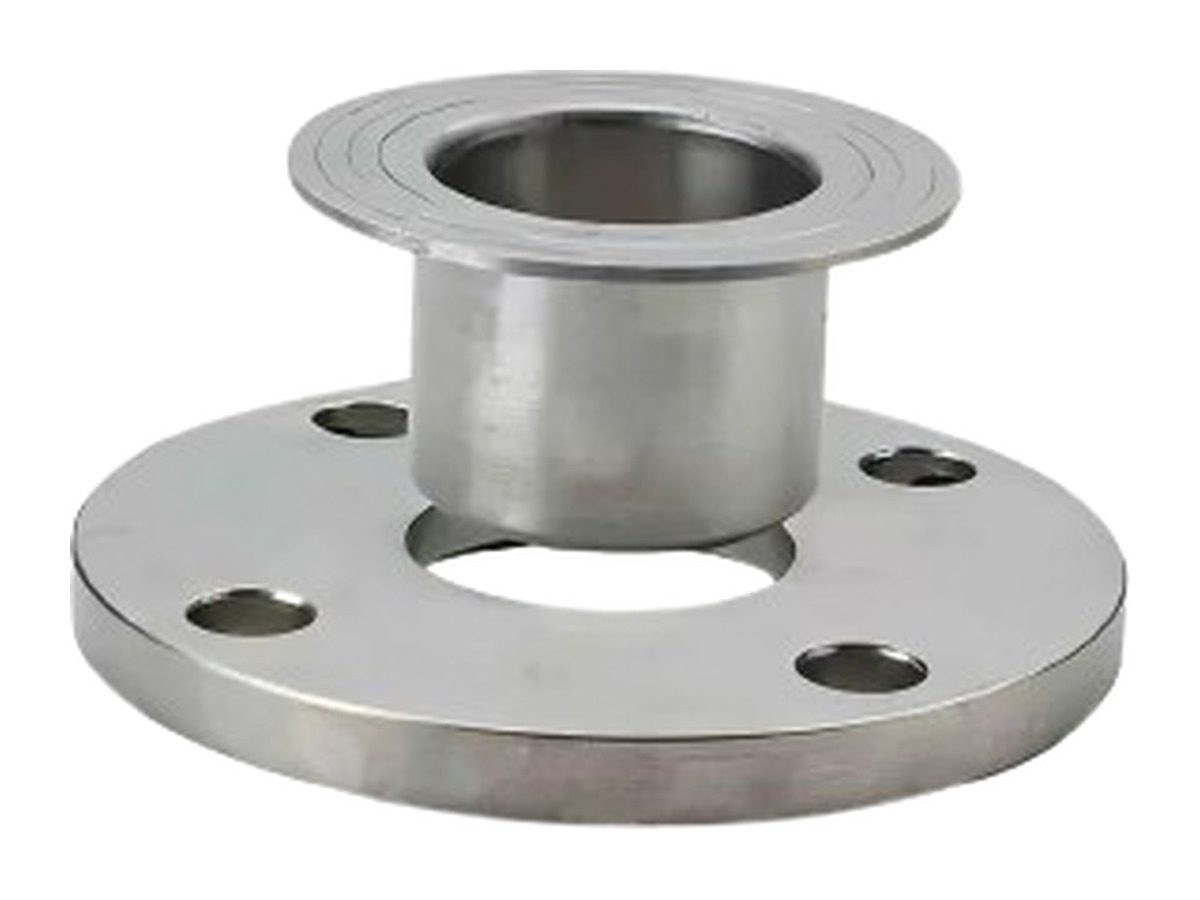
A lap joint flange is a two-piece assembly: a loose flange ring (also called a backing flange) plus a stub end. The stub end is butt welded to the pipe, and the flange ring sits loosely over it, free to rotate. Because the flange ring never contacts the process fluid, only the stub end does, the assembly allows the ring to be supplied in a lower-cost material while the stub end alone is matched to the service. The rotating ring also solves bolt hole alignment on large-diameter and multi-bolt joints. Lap joint flanges are used where lines are dismantled frequently, where the fluid is corrosive, and on non-ferrous piping systems. We manufacture carbon steel lap joint flanges and matching stub ends from our factory in Cangzhou, China's pipe-fitting industrial cluster, to ASME B16.5 and ASME B16.9 dimensions. Each shipment is accompanied by an EN 10204 3.1 Material Test Certificate.
Specifications
| Materials | ASTM A105 (carbon steel) for the flange ring and the stub end |
| Standards | Flange ring: ASME B16.5 (1/2 inch to 24 inch). Stub end: ASME B16.9. |
| Size Range | NPS 1/2 inch to 24 inch |
| Pressure Class | Class 150 to Class 2500 per ASME B16.5 dimensions. In practice, lap joint assemblies are most commonly used in Class 150 to Class 600. The pressure-temperature rating of the assembly is governed by the stub end material and wall thickness, not by the loose ring alone. |
| Flange Face Type | The sealing face is on the stub end, not on the flange ring. RF (Raised Face) — standard; FF (Flat Face) — on request. RTJ is not applicable to the lap joint configuration. |
| Bore | The stub end is butt welded to the pipe and its bore must match the pipe schedule. Pipe schedule must be specified at quotation stage. |
| Manufacturing Process | Flange ring: forged. Stub end: formed from seamless pipe or forged, machined to ASME B16.9. |
| Surface Treatment | Rust preventive oil + VCI film (standard for sea shipping); hot-dip galvanizing per ASTM A153; cold blackening; clear lacquer |
| MOQ | Negotiable based on specifications and destination port. Standard items can ship from a single pallet; custom orders typically require full container load. |
| Lead Time | Standard items ship within 7-15 days; custom orders and stub ends supplied to non-standard pipe schedules 20-35 days; shipping time additional depending on destination (typically 30-60 days sea voyage to Middle East ports) |
| HS Code | 7307.91 (carbon steel flanges); GCC Common External Tariff 5% on CIF value for Oman and UAE import |
| Customization | Non-standard sizes, long or short pattern stub ends, flange rings and stub ends in different material combinations, and modified dimensions are supported. Technical drawings or detailed specifications required for custom orders. |
| Documents | EN 10204 Type 3.1 MTC (standard with every shipment); impact test, hardness test, and NDT reports (UT / MT / PT) on request at quotation stage |
Application Scenarios
Commonly supplied to the following industries and applications:
- Corrosive or high-purity service where material cost matters — a lower-cost flange ring combined with a stub end matched to the fluid
- Lines dismantled frequently for cleaning, inspection, or batch changeover — the loose ring rotates, so the joint can be broken and remade without straining the pipe
- Large-diameter and multi-bolt joints where bolt hole alignment is difficult — the rotating ring removes the alignment problem
- Non-ferrous piping systems such as copper-nickel and aluminium — a carbon steel ring with a stub end matching the pipe material
- Desalination and seawater service — assemblies supplied with a stub end material matched to chloride exposure
- Temporary, skid-mounted, and modular piping that is assembled and dismantled repeatedly
- EPC contractors and overseas infrastructure projects — water transmission mains, district cooling networks, airport and industrial park piping, supplied to the project specification and the document package your QA team requires
Lap joint assemblies are not intended for high-pressure hydrocarbon, high-temperature cycling, or sour service. For those duties, weld neck flanges are the correct specification.
Samples, Third-Party Inspection and Test Records
Sample pieces can be produced before the batch runs, so that dimensions, bevel profile and fit-up can be checked on your side first. Sample cost and delivery time are advised with the quotation, based on size and material.
Buyer-nominated inspection is supported. SGS, BV, Intertek or your own inspector can witness dimensional checking, marking, coating and container loading at the production site, and we provide the documents and site access needed for the visit. Where a visit is not practical, the same checks can be followed through a live video walkthrough. Third-party inspection fees are normally carried by the buyer.
Non-destructive testing and hydrostatic test records are available on request and can be shipped with the order, together with the EN 10204 3.1 material certificate, the heat number and marking list, dimensional records, packing list and certificate of origin. Tell us at enquiry stage which records your project requires, and they are included in the quotation.
Lap Joint vs Weld Neck
| Criterion | Lap Joint (LJ) | Weld Neck (WN) |
|---|---|---|
| Assembly | Two pieces: loose ring plus stub end | One piece, integral hub |
| Ring Contacts Fluid | No, only the stub end does | Yes, the whole flange does |
| Material Cost Option | Ring and stub end can be different materials | Single material throughout |
| Rotates for Alignment | Yes, ring rotates freely | No, bolt holes fixed once welded |
| Pipe Schedule Required | Yes, for the stub end bore | Yes, for the flange bore |
| Pressure Class Range | Class 150 - 2500 per B16.5; commonly 150-600 | Class 150 - Class 2500 |
| High-Pressure Capability | Limited by stub end and ring support | Full rated capability |
| RTJ Facing | Not applicable | Available (standard from Class 900) |
| Frequent Dismantling | Well suited | Not suited, joint must be broken |
| Typical Applications | Corrosive service, non-ferrous pipe, frequent | Oil & gas, refinery, high-pressure steam, sour |
| dismantling, large-diameter alignment | service |
Selection Logic
Buyer FAQ
Q1: What is the actual difference between a lap joint flange and a weld neck flange?
A1: A weld neck flange is one piece, welded directly to the pipe, and the whole flange contacts the fluid. A lap joint flange is two pieces: a stub end that is butt welded to the pipe, and a loose flange ring that slides over the stub end and is free to rotate. Only the stub end contacts the fluid. The practical consequences are that the ring can be rotated to align bolt holes, that the joint is easier to break and remake, and that the two components can be supplied in different materials. The trade-off is that the assembly does not have the full pressure capability of an integral weld neck flange.
Q2: Is the stub end a separate item? Do I need to order it as well?
A2: Yes. A lap joint assembly requires both the flange ring and the stub end, and they are separate line items. The stub end is butt welded to the pipe, so its bore must be machined to match your pipe schedule. Please specify nominal pipe size, pressure class, and pipe schedule for the stub end, and confirm whether you need the long or short pattern. We supply both components and can quote them as a matched set. Ordering the ring without the stub end is a common purchasing error that leaves the assembly unusable on site.
Q3: Can a lap joint flange reduce material cost? How?
A3: That is the main economic reason to specify it. Because only the stub end contacts the process fluid, the flange ring can be supplied in a lower-cost material while the stub end alone is matched to the service. Where a corrosive or high-purity fluid would otherwise require an expensive alloy throughout, the saving is substantial — the ring is the heavier of the two components. Please share your fluid composition, temperature, and concentration, and we will confirm the suitable stub end grade and quote the assembly with a carbon steel ring.
Q4: Is a lap joint flange strong enough for high pressure?
A4: Lap joint assemblies are dimensioned in ASME B16.5 from Class 150 to Class 2500, but in practice they are most commonly used in Class 150 to Class 600. The pressure-temperature capability of the assembly is governed by the stub end material and wall thickness, and the loose ring provides less support to the joint than an integral hub. For high-pressure service, thermal cycling, hydrocarbon duty, or sour service, a weld neck flange is the correct specification. Please share your design pressure and temperature and we will confirm whether a lap joint assembly is suitable for your service.
Q5: Can I get RTJ facing on a lap joint flange?
A5: No. RTJ is not applicable to the lap joint configuration. The seal in a lap joint assembly is made between the stub end face and the gasket, and the flange ring only supplies the bolting clamp force. An RTJ groove must be machined into a fixed pressure-containing face, which the loose ring does not provide. If your piping class specifies RTJ, that is normally because the service is high pressure or high temperature, and a weld neck flange is the correct choice. RF is the standard facing for lap joint assemblies, with FF available on request.
Q6: What standard is the stub end supplied to? Long or short pattern?
A6: Stub ends are supplied to ASME B16.9. Long and short patterns are available, and the selection depends on the mating flange and the pipe schedule. Please specify the pipe schedule and the pattern required, or provide your piping class detail, and we will confirm the correct stub end. Note that the stub end is the pressure-containing component that is welded to your pipe, so it must match the pipe schedule exactly — a mismatch leaves a step at the weld and creates a stress riser at the worst location in the joint.
Q7: Is a lap joint flange suitable for lines that are dismantled frequently?
A7: Yes, this is one of the main reasons to specify them. Because the ring rotates freely, the joint can be broken and remade without rotating the pipe or springing the line, and bolt holes can be aligned quickly. This suits lines that are opened regularly for cleaning, inspection, or batch changeover. The gasket should be replaced each time the joint is broken, and the stub end face should be inspected for scoring, because the sealing face is reused every time.
Q8: Can lap joint flanges be used on copper-nickel or aluminium piping?
A8: Yes, and this is a common application. On non-ferrous piping, welding a steel flange directly to the pipe is not possible, so the stub end is supplied in a material matching the pipe and the flange ring is supplied in carbon steel. This gives a bolted joint that can be dismantled, without the cost of a solid non-ferrous flange. Please state the pipe material and specification so the stub end can be matched to it, and note that the dissimilar metal contact between ring and stub end should be considered in your corrosion assessment.
Q9: How is the gasket selected for a lap joint assembly?
A9: The gasket sits against the stub end face, and it is selected by the same rules as any RF joint: fluid compatibility, design pressure and temperature, and the facing type. A spiral wound gasket with a suitable filler and winding material is the common choice for RF. The gasket dimensions correspond to the nominal size and class of the assembly. One practical point: because the joint is often broken and remade, the stub end face finish matters — a scored face will not seal reliably on reassembly. Inspect the face and replace the gasket at every break.
Q10: What is the HS Code and tariff for carbon steel lap joint flanges imported into Oman and the UAE?
A10: Carbon steel lap joint flanges are classified under HS Code 7307.91 (tube or pipe fittings of iron or steel — flanges of iron or steel, other than stainless). GCC Common External Tariff is 5% on CIF value for goods imported into Oman and the UAE. Standard import documentation includes Commercial Invoice, Packing List, Bill of Lading, Certificate of Origin (Form A or applicable FTA), MTC 3.1, and Fumigation Certificate for wooden packaging. Since 2026, electronic Bayan (e-Bayan) declaration is mandatory for Oman customs clearance; UAE importers file through Dubai Customs or the relevant emirate portal. We can provide full export documentation support per your request.
Q11: What sizes and pressure ratings are available for carbon steel lap joint flanges?
A11: NPS 1/2 inch to 24 inch. Class 150 to Class 2500 per ASME B16.5 dimensions. Sizes and ratings outside this range can be reviewed against your drawing. The exact range confirmed for your order is stated in the quotation.
Q12: How is the wall thickness determined for carbon steel lap joint flanges?
A12: Flange dimensions, including hub and thickness, are fixed by the ASME standard for the size and pressure class you specify. They are not chosen separately. The matching pipe schedule is confirmed at quotation stage.
Q13: What is the lead time for carbon steel lap joint flanges?
A13: Standard sizes in regular material normally take 7-15 days. Non-standard sizes, special materials and custom orders take longer. The exact lead time for this product is given in the specification table on this page and is confirmed in writing with your quotation. Sea freight to the Gulf is additional and depends on the destination port. All lead times are subject to the production schedule at the time of order.
Q14: Is there a minimum order quantity for carbon steel lap joint flanges?
A14: There is no fixed minimum. Standard items can ship from a single pallet, and custom production is normally quoted at full container load. Small trial orders and mixed-size orders are accepted. Send your size list and we will confirm what can be combined in one shipment.
Q15: How are carbon steel lap joint flanges packed and marked?
A15: Flanges and fittings are packed in plywood cases or on plywood pallets with anti-rust treatment, strapped and stretch-wrapped for sea freight. Each piece carries the heat number, and the material, size, standard and pressure class or schedule are marked on the item or on the case label. Shipping marks are printed to your specification, and a fumigation certificate is provided where wooden packaging is used.
Q16: Can you produce carbon steel lap joint flanges to our drawing or to non-standard specifications?
A16: Yes. Send the drawing, material, quantity and the applicable standard, and we will confirm feasibility and quote. Non-standard angles, non-standard schedules, special materials and special dimensions are produced against your drawing. The details we need to quote are listed on our custom service page. The details we need to quote are listed on our custom service page.
Engineer's Note
The following technical guidance reflects the perspective of a senior piping engineer with extensive experience in industrial piping system design.
A lap joint assembly is not a cheaper weld neck flange. It is a different joint with a different load path, and it should be specified for its own strengths. The following factors should drive your specification:
- Understand the Two-Piece Structure
- The stub end is butt welded to the pipe and is the pressure-containing, fluid-contacting component
- The flange ring supplies only the bolting clamp force and never contacts the fluid
- The ring rotates freely; it does not transfer load the way an integral hub does
- Material Cost Is the Main Economic Reason
- Only the stub end needs to be matched to the fluid
- The ring, which is the heavier component, can be supplied in a lower-cost material
- Where an expensive alloy would otherwise be required throughout, the saving is significant
- Pressure Capability Has a Real Limit
- ASME B16.5 dimensions cover Class 150 to Class 2500, but field practice favours Class 150 to Class 600
- Capability is governed by the stub end material and wall thickness
- Not for high pressure, thermal cycling, hydrocarbon, or sour service — use weld neck
- RTJ Does Not Apply
- The sealing face is on the stub end; the ring only clamps
- An RTJ groove requires a fixed pressure-containing face
- If RTJ is specified, the service is normally high pressure or high temperature: use weld neck
- Alignment and Dismantling Are the Operational Strengths
- The rotating ring solves bolt hole alignment on large and multi-bolt joints
- Lines opened regularly for cleaning or inspection are the best application
- Replace the gasket and inspect the stub end face at every break
- Non-Ferrous Piping
- Copper-nickel and aluminium lines cannot be welded to a steel flange
- Supply the stub end in the pipe material and the ring in carbon steel
- Consider dissimilar metal contact in the corrosion assessment
- Common Mistakes to Avoid
- Ordering the ring without the stub end: the assembly cannot be installed
- Forgetting the pipe schedule: the stub end bore will not match the pipe
- Specifying lap joint to save cost on high-pressure or hydrocarbon lines
- Requesting RTJ facing on a lap joint assembly
- Assuming the flange ring carries the pressure: it does not
- Reusing a scored stub end face and expecting it to seal
For project-specific engineering support, please share your service conditions (size, class, design pressure and temperature, fluid composition, pipe schedule, pipe material, and dismantling frequency) and we will review the specification and provide a written recommendation.
Frequently Asked Questions
What is the actual difference between a lap joint flange and a weld neck flange?
A weld neck flange is one piece, welded directly to the pipe, and the whole flange contacts the fluid. A lap joint flange is two pieces: a stub end that is butt welded to the pipe, and a loose flange ring that slides over the stub end and is free to rotate. Only the stub end contacts the fluid. The practical consequences are that the ring can be rotated to align bolt holes, that the joint is easier to break and remake, and that the two components can be supplied in different materials. The trade-off is that the assembly does not have the full pressure capability of an integral weld neck flange.
Is the stub end a separate item? Do I need to order it as well?
Yes. A lap joint assembly requires both the flange ring and the stub end, and they are separate line items. The stub end is butt welded to the pipe, so its bore must be machined to match your pipe schedule. Please specify nominal pipe size, pressure class, and pipe schedule for the stub end, and confirm whether you need the long or short pattern. We supply both components and can quote them as a matched set. Ordering the ring without the stub end is a common purchasing error that leaves the assembly unusable on site.
Can a lap joint flange reduce material cost? How?
That is the main economic reason to specify it. Because only the stub end contacts the process fluid, the flange ring can be supplied in a lower-cost material while the stub end alone is matched to the service. Where a corrosive or high-purity fluid would otherwise require an expensive alloy throughout, the saving is substantial — the ring is the heavier of the two components. Please share your fluid composition, temperature, and concentration, and we will confirm the suitable stub end grade and quote the assembly with a carbon steel ring.
Is a lap joint flange strong enough for high pressure?
Lap joint assemblies are dimensioned in ASME B16.5 from Class 150 to Class 2500, but in practice they are most commonly used in Class 150 to Class 600. The pressure-temperature capability of the assembly is governed by the stub end material and wall thickness, and the loose ring provides less support to the joint than an integral hub. For high-pressure service, thermal cycling, hydrocarbon duty, or sour service, a weld neck flange is the correct specification. Please share your design pressure and temperature and we will confirm whether a lap joint assembly is suitable for your service.
Can I get RTJ facing on a lap joint flange?
No. RTJ is not applicable to the lap joint configuration. The seal in a lap joint assembly is made between the stub end face and the gasket, and the flange ring only supplies the bolting clamp force. An RTJ groove must be machined into a fixed pressure-containing face, which the loose ring does not provide. If your piping class specifies RTJ, that is normally because the service is high pressure or high temperature, and a weld neck flange is the correct choice. RF is the standard facing for lap joint assemblies, with FF available on request.
What standard is the stub end supplied to? Long or short pattern?
Stub ends are supplied to ASME B16.9. Long and short patterns are available, and the selection depends on the mating flange and the pipe schedule. Please specify the pipe schedule and the pattern required, or provide your piping class detail, and we will confirm the correct stub end. Note that the stub end is the pressure-containing component that is welded to your pipe, so it must match the pipe schedule exactly — a mismatch leaves a step at the weld and creates a stress riser at the worst location in the joint.
Is a lap joint flange suitable for lines that are dismantled frequently?
Yes, this is one of the main reasons to specify them. Because the ring rotates freely, the joint can be broken and remake without rotating the pipe or springing the line, and bolt holes can be aligned quickly. This suits lines that are opened regularly for cleaning, inspection, or batch changeover. The gasket should be replaced each time the joint is broken, and the stub end face should be inspected for scoring, because the sealing face is reused every time.
Can lap joint flanges be used on copper-nickel or aluminium piping?
Yes, and this is a common application. On non-ferrous piping, welding a steel flange directly to the pipe is not possible, so the stub end is supplied in a material matching the pipe and the flange ring is supplied in carbon steel. This gives a bolted joint that can be dismantled, without the cost of a solid non-ferrous flange. Please state the pipe material and specification so the stub end can be matched to it, and note that the dissimilar metal contact between ring and stub end should be considered in your corrosion assessment.
How is the gasket selected for a lap joint assembly?
The gasket sits against the stub end face, and it is selected by the same rules as any RF joint: fluid compatibility, design pressure and temperature, and the facing type. A spiral wound gasket with a suitable filler and winding material is the common choice for RF. The gasket dimensions correspond to the nominal size and class of the assembly. One practical point: because the joint is often broken and remade, the stub end face finish matters — a scored face will not seal reliably on reassembly. Inspect the face and replace the gasket at every break.
What is the HS Code and tariff for carbon steel lap joint flanges imported into Oman and the UAE?
Carbon steel lap joint flanges are classified under HS Code 7307.91 (tube or pipe fittings of iron or steel — flanges of iron or steel, other than stainless). GCC Common External Tariff is 5% on CIF value for goods imported into Oman and the UAE. Standard import documentation includes Commercial Invoice, Packing List, Bill of Lading, Certificate of Origin (Form A or applicable FTA), MTC 3.1, and Fumigation Certificate for wooden packaging. Since 2026, electronic Bayan (e-Bayan) declaration is mandatory for Oman customs clearance; UAE importers file through Dubai Customs or the relevant emirate portal. We can provide full export documentation support per your request.
What sizes and pressure ratings are available for carbon steel lap joint flanges?
NPS 1/2 inch to 24 inch. Class 150 to Class 2500 per ASME B16.5 dimensions. Sizes and ratings outside this range can be reviewed against your drawing. The exact range confirmed for your order is stated in the quotation.
How is the wall thickness determined for carbon steel lap joint flanges?
Flange dimensions, including hub and thickness, are fixed by the ASME standard for the size and pressure class you specify. They are not chosen separately. The matching pipe schedule is confirmed at quotation stage.
What is the lead time for carbon steel lap joint flanges?
Standard sizes in regular material normally take 7-15 days. Non-standard sizes, special materials and custom orders take longer. The exact lead time for this product is given in the specification table on this page and is confirmed in writing with your quotation. Sea freight to the Gulf is additional and depends on the destination port. All lead times are subject to the production schedule at the time of order.
Is there a minimum order quantity for carbon steel lap joint flanges?
There is no fixed minimum. Standard items can ship from a single pallet, and custom production is normally quoted at full container load. Small trial orders and mixed-size orders are accepted. Send your size list and we will confirm what can be combined in one shipment.
How are carbon steel lap joint flanges packed and marked?
Flanges and fittings are packed in plywood cases or on plywood pallets with anti-rust treatment, strapped and stretch-wrapped for sea freight. Each piece carries the heat number, and the material, size, standard and pressure class or schedule are marked on the item or on the case label. Shipping marks are printed to your specification, and a fumigation certificate is provided where wooden packaging is used.
Can you produce carbon steel lap joint flanges to our drawing or to non-standard specifications?
Yes. Send the drawing, material, quantity and the applicable standard, and we will confirm feasibility and quote. Non-standard angles, non-standard schedules, special materials and special dimensions are produced against your drawing. The details we need to quote are listed on our custom service page.