
 1 / 4
Description
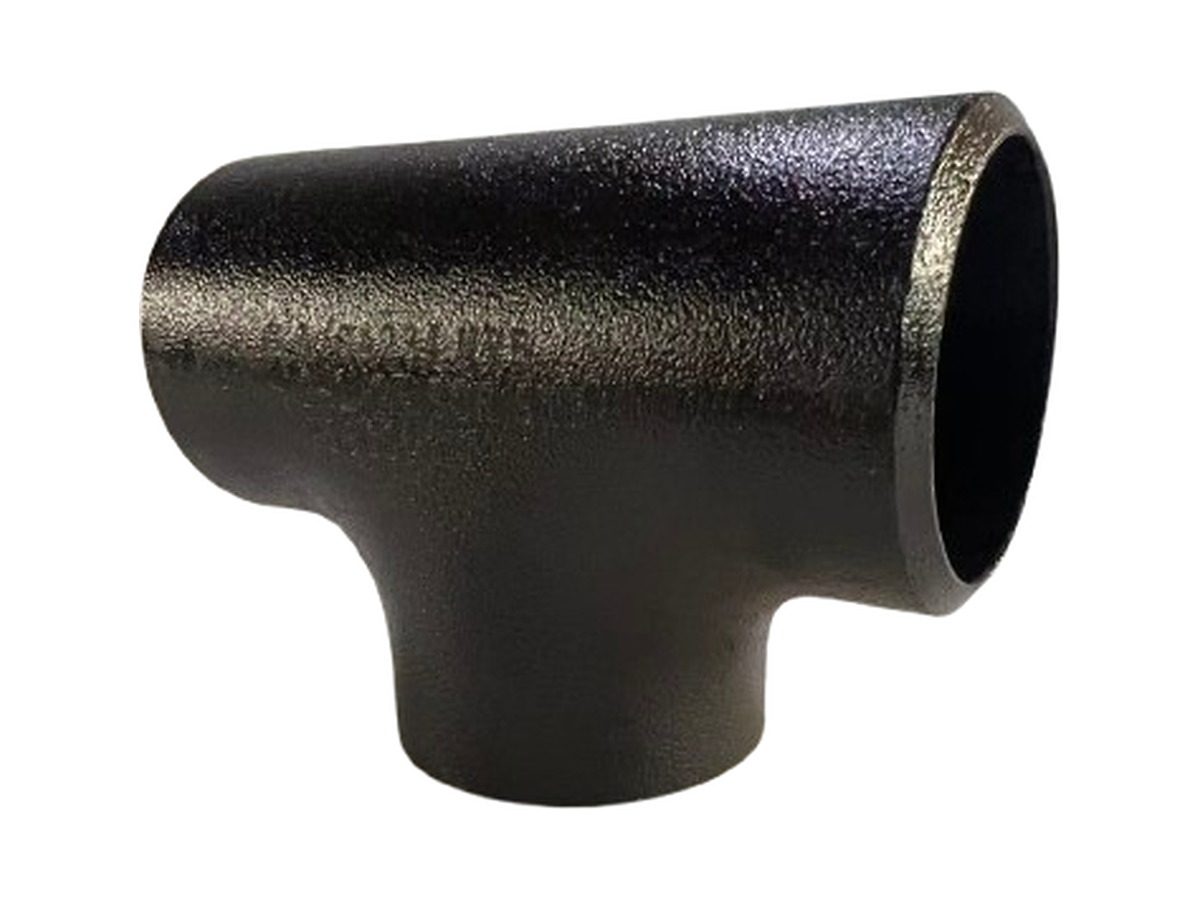
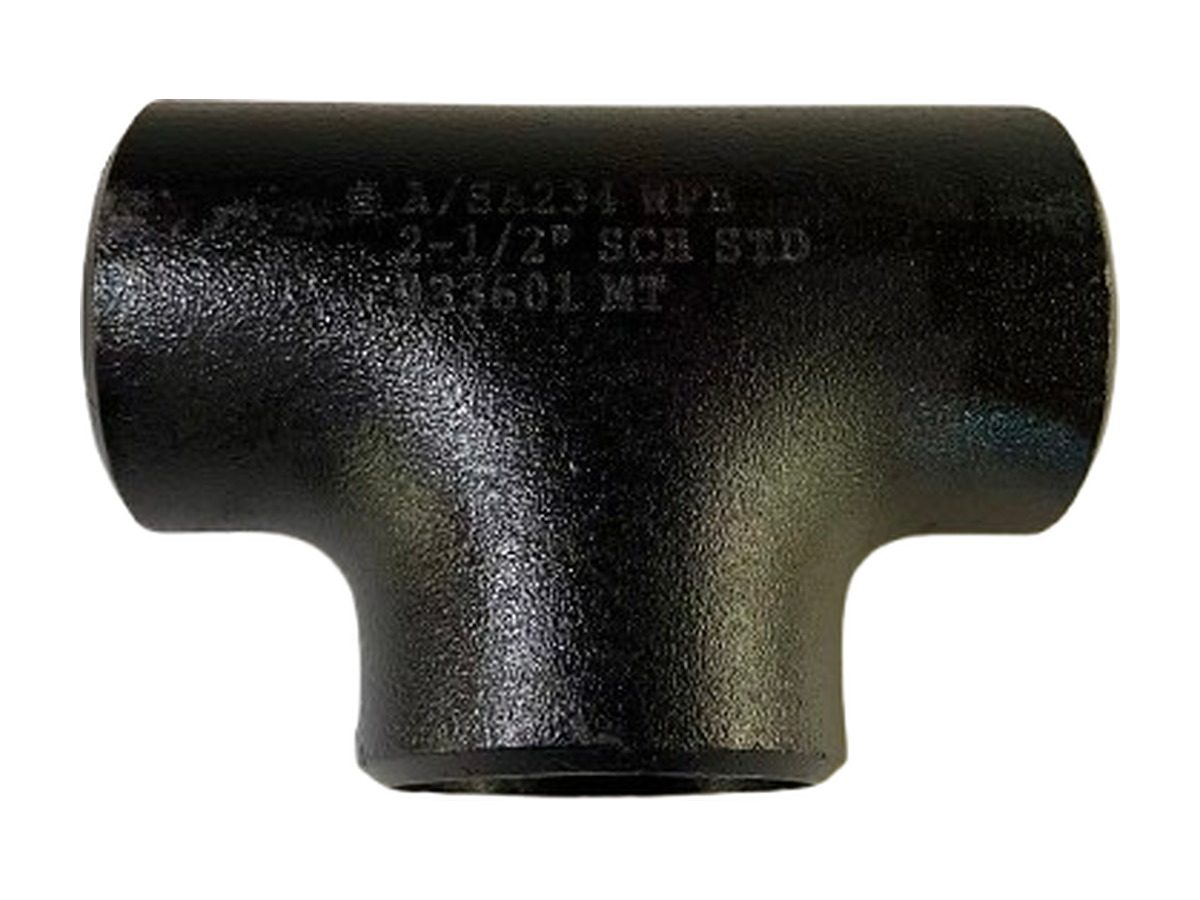
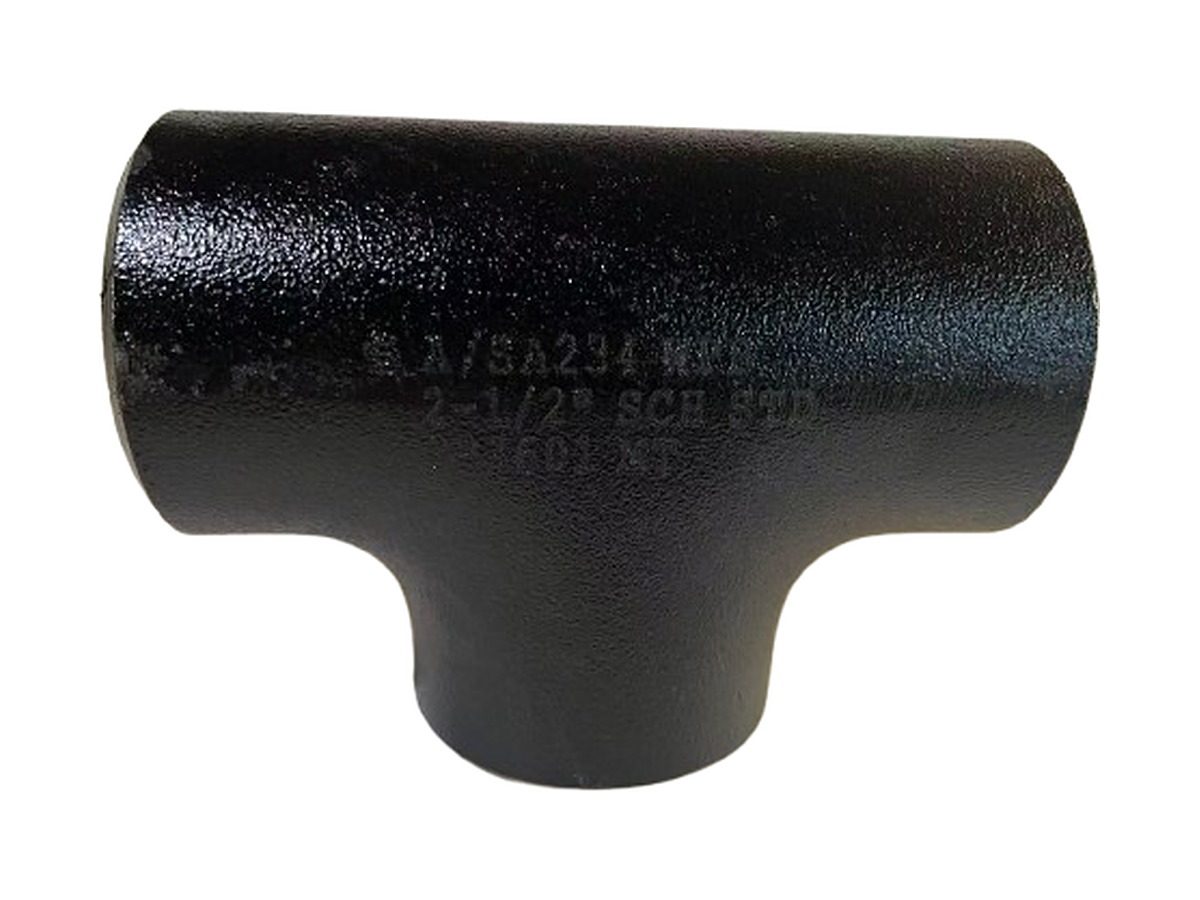
A butt weld tee creates a branch on a pipeline. All three ends are welded to the pipe with full penetration butt welds, so the fitting and the pipe form one continuous pressure boundary with no threaded or socket cavity. We manufacture carbon steel tees in two types. A straight tee, also called an equal tee, has an outlet the same size as the run, and is used where the branch is full size: headers feeding branches of the same diameter, lines that must be pigged, and full-bore take-offs. A reducing tee has an outlet smaller than the run, and is used to take a smaller branch off a header — utility take-offs, instrument connections, firewater sprinkler branches, and distribution lines. Unlike flanges, butt weld fittings do not carry a pressure class. The wall thickness is specified by pipe schedule, and the pressure capability follows from the schedule, the material, and the applicable piping code. Please state the run size, the outlet size, and the schedule of both. We manufacture carbon steel tees from our factory in Cangzhou, China's pipe-fitting industrial cluster, to ASME B16.9. Each shipment is accompanied by an EN 10204 3.1 Material Test Certificate.
Carbon Steel Butt Weld Tees — Straight (Equal) and Reducing
Specifications
| Materials | ASTM A234 WPB (carbon steel) |
| Standards | ASME B16.9 (factory-made wrought butt welding fittings, straight and reducing tees) |
| Type | Straight tee, also called equal tee — outlet the same size as the run; Reducing tee — outlet smaller than the run |
| Size Range | NPS 1/2 inch to 24 inch as standard in seamless construction; larger sizes up to 48 inch in welded construction on request |
| Size Callout | Straight tee — one size, for example NPS 6. Reducing tee — three numbers in the order run x run x outlet, for example NPS 6 x 6 x 4, where the third number is the branch |
| Pressure Rating | Butt weld fittings do not carry a pressure class. Wall thickness is specified by pipe schedule (SCH 10 / 20 / 40 / 80 / 120 / 160 / XS / XXS), and the pressure-temperature capability is determined by the pipe schedule, the material, and the applicable piping code such as ASME B31.3. Please state the schedule at quotation stage. |
| Wall Thickness | Specified by pipe schedule. On a reducing tee the schedule of the run and the schedule of the outlet must both be stated, because they are not always the same. |
| Manufacturing Process | Seamless as standard up to NPS 24, with the outlet formed by hot extrusion or cold forming; welded construction for larger sizes. Heat treatment as required by the material specification. |
| End Preparation | Bevelled ends to ASME B16.25 for butt welding, on all three ends |
| Surface Treatment | Rust preventive oil + VCI film (standard for sea shipping); hot-dip galvanizing per ASTM A153; cold blackening; clear lacquer |
| MOQ | Negotiable based on specifications and destination port. Standard items can ship from a single pallet; custom orders typically require full container load. |
| Lead Time | Standard items ship within 7-15 days; custom orders and non-standard sizes, schedules, or reducing combinations 20-35 days; shipping time additional depending on destination (typically 30-60 days sea voyage to Middle East ports) |
| HS Code | 7307.93 (butt welding fittings of iron or steel); GCC Common External Tariff 5% on CIF value for Oman and UAE import |
| Customization | Non-standard reducing combinations, non-standard wall thickness, 45 degree lateral (Y) tees, and special dimensions are supported. Technical drawings or detailed specifications required for custom orders. |
| Documents | EN 10204 Type 3.1 MTC (standard with every shipment); impact test, hardness test, and NDT reports (UT / MT / PT / RT) on request at quotation stage |
Application Scenarios
Commonly supplied to the following industries and applications:
- Oil and gas gathering, transmission, and refinery process piping — branch take-offs from headers in SCH 40 to SCH 160
- Petrochemical and chemical plant process lines, where headers distribute to multiple units
- Power generation — steam, condensate, feedwater, and cooling water distribution
- Water treatment and desalination — intake, pretreatment, and product water distribution headers
- Firewater ring mains and sprinkler systems — reducing tees feeding smaller branch lines
- Utility and service headers — instrument air, nitrogen, plant water, and drainage, where many small take-offs come off one run
- Instrument, vent, and drain connections, taken off the run with a reducing tee
- Skid-mounted and modular packages, where tees are welded and pressure tested in the shop
- Pigged lines, where a straight tee keeps the bore full and the branch full size
- EPC contractors and overseas infrastructure projects — water transmission mains, district cooling networks, airport and industrial park piping, supplied to the project specification and the document package your QA team requires
Butt weld tees are not intended for lines that must be dismantled frequently. For those locations, a flanged branch or a flanged tee is the correct solution.
Samples, Third-Party Inspection and Test Records
Sample pieces can be produced before the batch runs, so that dimensions, bevel profile and fit-up can be checked on your side first. Sample cost and delivery time are advised with the quotation, based on size and material.
Buyer-nominated inspection is supported. SGS, BV, Intertek or your own inspector can witness dimensional checking, marking, coating and container loading at the production site, and we provide the documents and site access needed for the visit. Where a visit is not practical, the same checks can be followed through a live video walkthrough. Third-party inspection fees are normally carried by the buyer.
Non-destructive testing and hydrostatic test records are available on request and can be shipped with the order, together with the EN 10204 3.1 material certificate, the heat number and marking list, dimensional records, packing list and certificate of origin. Tell us at enquiry stage which records your project requires, and they are included in the quotation.
Straight Tee vs Reducing Tee
| Criterion | Straight Tee (Equal Tee) | Reducing Tee |
|---|---|---|
| Outlet Size | Same as the run | Smaller than the run |
| Size Callout | One size, for example NPS 6 | Three numbers: run x run x outlet, for example 6 x 6 x 4 |
| Bore | Full bore through the run and the outlet | Reduced bore at the outlet |
| Branch Flow | Matches the run | Limited by the outlet size |
| Pressure Drop at Branch | Lower | Higher, because the flow contracts into a smaller outlet |
| Weight and Material | Heavier, more material | Lighter, usually less material |
| Pigging | Suitable, the branch is full size | Not suitable through the branch |
| Typical Use | Headers feeding same-size branches, pigged lines, full-bore take-offs | Distribution headers, utility and instrument take-offs, firewater sprinkler branches |
| Standard | ASME B16.9 | ASME B16.9 |
Size Callout Rule
- Straight tee — one number is enough: NPS 6
- Reducing tee — three numbers, in the order run x run x outlet: NPS 6 x 6 x 4 means a 6 inch run with a 4 inch branch
- The third number is always the branch. Getting this wrong is the most common ordering error
- State the schedule of the run and the schedule of the outlet separately
Selection Logic
Buyer FAQ
Q1: How do I specify the size of a reducing tee?
A1: A straight tee takes one number — NPS 6 means a 6 inch run with a 6 inch outlet. A reducing tee takes three numbers, always in the order run x run x outlet. NPS 6 x 6 x 4 means a 6 inch run with a 4 inch branch. The third number is the branch, and this is the single most common ordering error we see: the two numbers get reversed and the customer receives a 4 inch run with a 6 inch branch, which does not fit the line. Please also state the schedule of the run and the schedule of the outlet separately, because they are not always the same. If you send us a line list or an isometric drawing, we will read the sizes off it and confirm before production.
Q2: Do tees have a pressure class like Class 150 or Class 300?
A2: No. Butt weld fittings such as tees and elbows do not carry a pressure class the way flanges do. A flange is rated Class 150, Class 300 and so on because it is a complete pressure-containing component with its own bolting and gasket. A tee is part of the pipe: its wall thickness is specified by pipe schedule, and its pressure capability follows from that schedule, the material, and the applicable piping code. There is a second reason this matters on a tee: the branch opening removes metal from the run, so the tee is not simply a piece of pipe. Wall thickness still follows the schedule, but the geometry at the branch is why the tee needs to be supported and analysed properly. If you ask for a Class 150 tee, we will ask which pipe schedule you need.
Q3: When should I use a butt weld tee, and when is a branch outlet fitting the better choice?
A3: A butt weld tee is the strongest and most conservative option. All three ends are full penetration butt welds, the fitting is a standard ASME B16.9 component, and it suits high pressure, high temperature, cyclic service, and lines that must be pigged. A branch outlet fitting — the type commonly known as a weldolet or olet, made to MSS SP-97 — is welded directly onto a hole cut in the run. It uses less material, takes less space, and is usually more economical for small branch take-offs. It is widely used for instrument connections, vents, drains, and utility take-offs on low and moderate pressure lines. Choose based on the pressure and temperature, the ratio of branch size to run size, whether the line is pigged, and whether the service is cyclic. Tell us the service and we will tell you which one we would quote.
Q4: Can I use a standard tee when the branch is nearly as large as the run?
A4: Standard reducing tees are produced in the size combinations covered by ASME B16.9. As the branch size approaches the run size, the opening removes more metal from the run and the reinforcement required increases. In those cases the correct solutions are usually one of three: a straight tee with a reducer on the branch, a 45 degree lateral (Y) tee, which takes the branch off at an angle and disturbs the run less, or a reinforced branch connection designed and calculated for the specific geometry. The choice depends on the pressure, the temperature, and the piping code the line is built to, so please send us the sizes, the design conditions, and the applicable code, and we will confirm what can be supplied as a standard fitting and what needs to be calculated.
Q5: Are the run and the outlet the same wall thickness on a reducing tee?
A5: Often they are, but not always, and it must be stated. A standard reducing tee is commonly supplied with the same schedule on all three ends. There are cases where the outlet is specified heavier than the run, for example where the branch sees a higher pressure or where the branch line is a different piping class. There are also cases where the run is heavier because the header carries more load. Because the two can differ, please give us the run schedule and the outlet schedule separately on your enquiry. If you only give one number, we will quote one schedule throughout and confirm it with you before production.
Q6: Why is the tee called a stress concentration point, and what does that mean for installation?
A6: The geometry changes abruptly where the branch meets the run — this area is called the crotch — and stress concentrates there. Under thermal expansion, vibration, or cyclic loading, this is the location where a branch connection is most likely to crack. Three practical consequences follow. First, the tee should be supported: do not let the weight of the branch line or the attached equipment hang off the crotch. Second, on hot lines and on lines with significant thermal movement, the branch needs enough flexibility, or an anchor and a guide, so that the movement is absorbed by the pipe rather than by the fitting. Third, high temperature, high pressure, or cyclic service should be stress analysed rather than laid out by eye. None of this changes the fitting you order, but it changes how long the joint lasts.
Q7: Can you supply 45 degree lateral tees or Y tees?
A7: Yes, as a custom item. A 45 degree lateral, sometimes called a Y tee, takes the branch off at 45 degrees to the run instead of 90 degrees. It is used where flow enters the branch more smoothly, where pressure drop at the branch matters, and as an alternative when the branch is a large fraction of the run size. Laterals are not covered as standard dimensions in ASME B16.9, so they are made to your drawing. Please send the drawing with the run size, the branch size, the angle, the schedule, and the material, and we will confirm feasibility and lead time. Custom laterals normally take longer than standard tees and usually require a full container quantity.
Q8: What marking and end preparation do carbon steel tees come with?
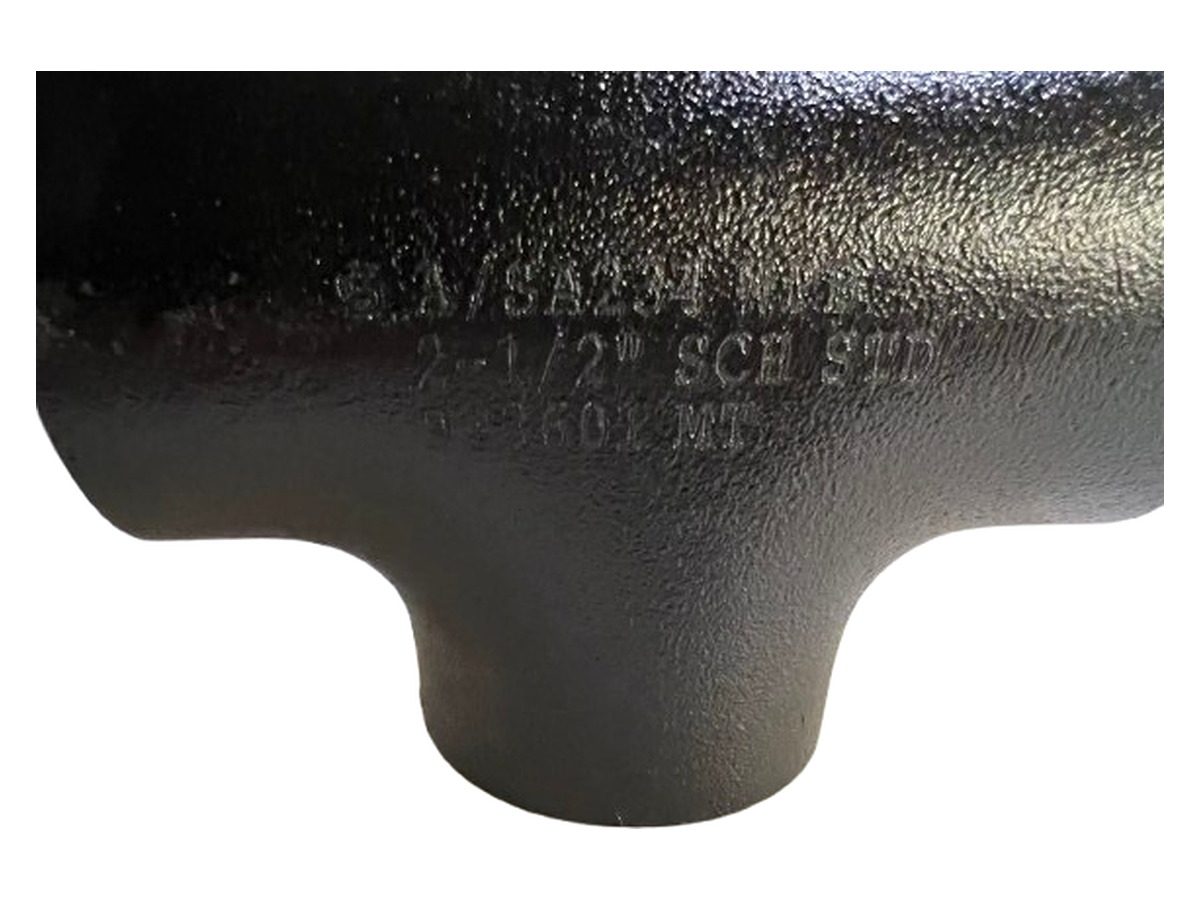
A8: Standard marking includes the manufacturer's identification, the material grade (A234 WPB), the size — including all three numbers on a reducing tee — the schedule or wall thickness, the standard (ASME B16.9), and the heat number for traceability back to the MTC. Marking is by steel stamp, laser engraving, or paint stencil depending on the size and your preference. All three ends are bevelled for butt welding to ASME B16.25 as standard. The bevel suits the wall thickness, so the schedule you specify also determines the bevel. If your welding procedure requires a specific bevel geometry, tell us at quotation stage and we will confirm.
Q9: Can tees be used on sour service or high-temperature service?
A9: They can, but the material condition has to suit the service. For sour service the fitting must meet NACE MR0175 / ISO 15156 requirements, including hardness limits, and the MTC must show compliance. Standard A234 WPB is not automatically sour service compliant. For high-temperature service, the allowable stress of the material falls as the temperature rises, so the schedule has to be selected against the design temperature, not just the design pressure. Please state if H2S is present, with the partial pressure, and give us the design pressure and temperature, and we will confirm the correct material, heat treatment, and documentation rather than quoting a standard fitting by default.
Q10: What is the HS Code and tariff for carbon steel tees imported into Oman and the UAE?
A10: Carbon steel butt weld tees are classified under HS Code 7307.93 (butt welding fittings of iron or steel). This is the same heading as elbows and other butt weld fittings, and it is different from flanges, which fall under 7307.91. GCC Common External Tariff is 5% on CIF value for goods imported into Oman and the UAE. Standard import documentation includes Commercial Invoice, Packing List, Bill of Lading, Certificate of Origin (Form A or applicable FTA), MTC 3.1, and Fumigation Certificate for wooden packaging. Since 2026, electronic Bayan (e-Bayan) declaration is mandatory for Oman customs clearance; UAE importers file through Dubai Customs or the relevant emirate portal. We can provide full export documentation support per your request.
Q11: What sizes and pressure ratings are available for butt weld tees?
A11: NPS 1/2 inch to 24 inch as standard in seamless construction, with larger sizes up to 48 inch in welded construction on request. Wall thickness is specified by pipe schedule. Sizes and ratings outside this range can be reviewed against your drawing. The exact range confirmed for your order is stated in the quotation.
Q12: How is the wall thickness determined for butt weld tees?
A12: Butt-weld fittings do not carry a pressure class. Wall thickness is specified by the pipe schedule (SCH 10 / 20 / 40 / 80 / 120 / 160 / XS / XXS), and the schedule must be stated when you request a quotation. On a reducing tee, the schedule of the run and the schedule of the outlet must both be stated, because they are not always the same.
Q13: What is the lead time for butt weld tees?
A13: Standard sizes in regular material normally take 7-15 days. Non-standard sizes, special materials and custom orders take longer. The exact lead time for this product is given in the specification table on this page and is confirmed in writing with your quotation. Sea freight to the Gulf is additional and depends on the destination port. All lead times are subject to the production schedule at the time of order.
Q14: Is there a minimum order quantity for butt weld tees?
A14: There is no fixed minimum. Standard items can ship from a single pallet, and custom production is normally quoted at full container load. Small trial orders and mixed-size orders are accepted. Send your size list and we will confirm what can be combined in one shipment.
Q15: How are butt weld tees packed and marked?
A15: Flanges and fittings are packed in plywood cases or on plywood pallets with anti-rust treatment, strapped and stretch-wrapped for sea freight. Each piece carries the heat number, and the material, size, standard and pressure class or schedule are marked on the item or on the case label. Shipping marks are printed to your specification, and a fumigation certificate is provided where wooden packaging is used.
Q16: Can you produce butt weld tees to our drawing or to non-standard specifications?
A16: Yes. Send the drawing, material, quantity and the applicable standard, and we will confirm feasibility and quote. Non-standard angles, non-standard schedules, special materials and special dimensions are produced against your drawing. The details we need to quote are listed on our custom service page. The details we need to quote are listed on our custom service page.
Engineer's Note
The following technical guidance reflects the perspective of a senior piping engineer with extensive experience in industrial piping system design.
A tee is the fitting that turns a single line into a system. It is also the most common source of layout errors and of long-term cracking, because a branch connection is where geometry, stress, and fabrication all meet in one place. The following factors should drive your specification:
- Tees Do Not Have a Pressure Class
- Wall thickness is specified by pipe schedule, not by Class 150 or Class 300
- The pressure capability follows from the schedule, the material, and the piping code
- The branch opening removes metal from the run, so the tee is not simply a piece of pipe
- Asking for a "Class 150 tee" is a specification error; ask for a schedule instead
- Get the Size Callout Right
- Straight tee: one number, NPS 6
- Reducing tee: three numbers in the order run x run x outlet, NPS 6 x 6 x 4
- The third number is always the branch
- State the run schedule and the outlet schedule separately
- Three Ways to Make a Branch
- Butt weld tee to ASME B16.9: the strongest option, standard component, suits high pressure, high temperature, cyclic service, and pigged lines
- Branch outlet fitting to MSS SP-97, commonly known as a weldolet or olet: less material, less space, more economical for small take-offs on low and moderate pressure lines
- Reinforced fabricated branch: calculated for the geometry, used mainly on large-diameter, low-pressure lines
- Choose on pressure, temperature, branch-to-run ratio, pigging, and whether the service is cyclic
- Large Branches Need Thought
- As the branch approaches the run size, the opening removes more metal and the reinforcement demand rises
- Options: straight tee plus a reducer, a 45 degree lateral (Y tee), or a calculated reinforced branch connection
- Laterals are not standard ASME B16.9 dimensions and are made to drawing
- The Crotch Is Where It Cracks
- The junction between the branch and the run concentrates stress
- Support the tee; do not hang branch weight or equipment off the crotch
- On hot lines, provide flexibility, or an anchor and a guide, so movement is absorbed by the pipe
- Stress analyse high temperature, high pressure, or cyclic service rather than laying it out by eye
- The Right Material Callout Is A234 WPB
- A234 WPB is the wrought fitting specification: tees, elbows, reducers, caps
- A105 is the forging specification for flanges
- They are not interchangeable as material callouts
- Sour Service and High Temperature Need a Specific Callout
- Standard A234 WPB is not automatically NACE MR0175 / ISO 15156 compliant
- Hardness limits, heat treatment, and MTC content must be specified
- Declare H2S at quotation stage
- Select the schedule against the design temperature, not only the design pressure
- Ends and Traceability
- Bevels to ASME B16.25 as standard on all three ends; special bevel geometry on request
- Every fitting marked with grade, all three sizes on reducing tees, schedule, standard, and heat number
- The heat number links the fitting to its EN 10204 3.1 MTC
- Common Mistakes to Avoid
- Reversing the numbers on a reducing tee, so the branch is made larger than the run
- Asking for a pressure class instead of a pipe schedule
- Giving one schedule when the run and the outlet need different ones
- Hanging branch weight or equipment off the crotch with no support
- Using a standard reducing tee where the branch is so large that reinforcement is required
- Specifying A105 for a tee, or A234 WPB for a flange
- Declaring sour service only after the order is placed
For project-specific engineering support, please share your service conditions (run size, outlet size, schedules, type of branch, design pressure and temperature, fluid composition, H2S content, pigging requirement, seamless or welded, and examination requirements) and we will review the specification and provide a written recommendation.
Frequently Asked Questions
How do I specify the size of a reducing tee?
A straight tee takes one number — NPS 6 means a 6 inch run with a 6 inch outlet. A reducing tee takes three numbers, always in the order run x run x outlet. NPS 6 x 6 x 4 means a 6 inch run with a 4 inch branch. The third number is the branch, and this is the single most common ordering error we see: the two numbers get reversed and the customer receives a 4 inch run with a 6 inch branch, which does not fit the line. Please also state the schedule of the run and the schedule of the outlet separately, because they are not always the same. If you send us a line list or an isometric drawing, we will read the sizes off it and confirm before production.
Do tees have a pressure class like Class 150 or Class 300?
No. Butt weld fittings such as tees and elbows do not carry a pressure class the way flanges do. A flange is rated Class 150, Class 300 and so on because it is a complete pressure-containing component with its own bolting and gasket. A tee is part of the pipe: its wall thickness is specified by pipe schedule, and its pressure capability follows from that schedule, the material, and the applicable piping code. There is a second reason this matters on a tee: the branch opening removes metal from the run, so the tee is not simply a piece of pipe. Wall thickness still follows the schedule, but the geometry at the branch is why the tee needs to be supported and analysed properly. If you ask for a Class 150 tee, we will ask which pipe schedule you need.
When should I use a butt weld tee, and when is a branch outlet fitting the better choice?
A butt weld tee is the strongest and most conservative option. All three ends are full penetration butt welds, the fitting is a standard ASME B16.9 component, and it suits high pressure, high temperature, cyclic service, and lines that must be pigged. A branch outlet fitting — the type commonly known as a weldolet or olet, made to MSS SP-97 — is welded directly onto a hole cut in the run. It uses less material, takes less space, and is usually more economical for small branch take-offs. It is widely used for instrument connections, vents, drains, and utility take-offs on low and moderate pressure lines. Choose based on the pressure and temperature, the ratio of branch size to run size, whether the line is pigged, and whether the service is cyclic. Tell us the service and we will tell you which one we would quote.
Can I use a standard tee when the branch is nearly as large as the run?
Standard reducing tees are produced in the size combinations covered by ASME B16.9. As the branch size approaches the run size, the opening removes more metal from the run and the reinforcement required increases. In those cases the correct solutions are usually one of three: a straight tee with a reducer on the branch, a 45 degree lateral (Y) tee, which takes the branch off at an angle and disturbs the run less, or a reinforced branch connection designed and calculated for the specific geometry. The choice depends on the pressure, the temperature, and the piping code the line is built to, so please send us the sizes, the design conditions, and the applicable code, and we will confirm what can be supplied as a standard fitting and what needs to be calculated.
Are the run and the outlet the same wall thickness on a reducing tee?
Often they are, but not always, and it must be stated. A standard reducing tee is commonly supplied with the same schedule on all three ends. There are cases where the outlet is specified heavier than the run, for example where the branch sees a higher pressure or where the branch line is a different piping class. There are also cases where the run is heavier because the header carries more load. Because the two can differ, please give us the run schedule and the outlet schedule separately on your enquiry. If you only give one number, we will quote one schedule throughout and confirm it with you before production.
Why is the tee called a stress concentration point, and what does that mean for installation?
The geometry changes abruptly where the branch meets the run — this area is called the crotch — and stress concentrates there. Under thermal expansion, vibration, or cyclic loading, this is the location where a branch connection is most likely to crack. Three practical consequences follow. First, the tee should be supported: do not let the weight of the branch line or the attached equipment hang off the crotch. Second, on hot lines and on lines with significant thermal movement, the branch needs enough flexibility, or an anchor and a guide, so that the movement is absorbed by the pipe rather than by the fitting. Third, high temperature, high pressure, or cyclic service should be stress analysed rather than laid out by eye. None of this changes the fitting you order, but it changes how long the joint lasts.
Can you supply 45 degree lateral tees or Y tees?
Yes, as a custom item. A 45 degree lateral, sometimes called a Y tee, takes the branch off at 45 degrees to the run instead of 90 degrees. It is used where flow enters the branch more smoothly, where pressure drop at the branch matters, and as an alternative when the branch is a large fraction of the run size. Laterals are not covered as standard dimensions in ASME B16.9, so they are made to your drawing. Please send the drawing with the run size, the branch size, the angle, the schedule, and the material, and we will confirm feasibility and lead time. Custom laterals normally take longer than standard tees and usually require a full container quantity.
What marking and end preparation do carbon steel tees come with?
Standard marking includes the manufacturer's identification, the material grade (A234 WPB), the size — including all three numbers on a reducing tee — the schedule or wall thickness, the standard (ASME B16.9), and the heat number for traceability back to the MTC. Marking is by steel stamp, laser engraving, or paint stencil depending on the size and your preference. All three ends are bevelled for butt welding to ASME B16.25 as standard. The bevel suits the wall thickness, so the schedule you specify also determines the bevel. If your welding procedure requires a specific bevel geometry, tell us at quotation stage and we will confirm.
Can tees be used on sour service or high-temperature service?
They can, but the material condition has to suit the service. For sour service the fitting must meet NACE MR0175 / ISO 15156 requirements, including hardness limits, and the MTC must show compliance. Standard A234 WPB is not automatically sour service compliant. For high-temperature service, the allowable stress of the material falls as the temperature rises, so the schedule has to be selected against the design temperature, not just the design pressure. Please state if H2S is present, with the partial pressure, and give us the design pressure and temperature, and we will confirm the correct material, heat treatment, and documentation rather than quoting a standard fitting by default.
What is the HS Code and tariff for carbon steel tees imported into Oman and the UAE?
Carbon steel butt weld tees are classified under HS Code 7307.93 (butt welding fittings of iron or steel). This is the same heading as elbows and other butt weld fittings, and it is different from flanges, which fall under 7307.91. GCC Common External Tariff is 5% on CIF value for goods imported into Oman and the UAE. Standard import documentation includes Commercial Invoice, Packing List, Bill of Lading, Certificate of Origin (Form A or applicable FTA), MTC 3.1, and Fumigation Certificate for wooden packaging. Since 2026, electronic Bayan (e-Bayan) declaration is mandatory for Oman customs clearance; UAE importers file through Dubai Customs or the relevant emirate portal. We can provide full export documentation support per your request.
What sizes and pressure ratings are available for butt weld tees?
NPS 1/2 inch to 24 inch as standard in seamless construction, with larger sizes up to 48 inch in welded construction on request. Wall thickness is specified by pipe schedule. Sizes and ratings outside this range can be reviewed against your drawing. The exact range confirmed for your order is stated in the quotation.
How is the wall thickness determined for butt weld tees?
Butt-weld fittings do not carry a pressure class. Wall thickness is specified by the pipe schedule (SCH 10 / 20 / 40 / 80 / 120 / 160 / XS / XXS), and the schedule must be stated when you request a quotation. On a reducing tee, the schedule of the run and the schedule of the outlet must both be stated, because they are not always the same.
What is the lead time for butt weld tees?
Standard sizes in regular material normally take 7-15 days. Non-standard sizes, special materials and custom orders take longer. The exact lead time for this product is given in the specification table on this page and is confirmed in writing with your quotation. Sea freight to the Gulf is additional and depends on the destination port. All lead times are subject to the production schedule at the time of order.
Is there a minimum order quantity for butt weld tees?
There is no fixed minimum. Standard items can ship from a single pallet, and custom production is normally quoted at full container load. Small trial orders and mixed-size orders are accepted. Send your size list and we will confirm what can be combined in one shipment.
How are butt weld tees packed and marked?
Flanges and fittings are packed in plywood cases or on plywood pallets with anti-rust treatment, strapped and stretch-wrapped for sea freight. Each piece carries the heat number, and the material, size, standard and pressure class or schedule are marked on the item or on the case label. Shipping marks are printed to your specification, and a fumigation certificate is provided where wooden packaging is used.
Can you produce butt weld tees to our drawing or to non-standard specifications?
Yes. Send the drawing, material, quantity and the applicable standard, and we will confirm feasibility and quote. Non-standard angles, non-standard schedules, special materials and special dimensions are produced against your drawing. The details we need to quote are listed on our custom service page.
Related products
- 90° butt weld elbows
- stainless steel butt weld elbows
- carbon steel weld neck flanges
- EN 10204 3.1 material certificate
- ASTM A234 WPB tees