
 1 / 3
Description
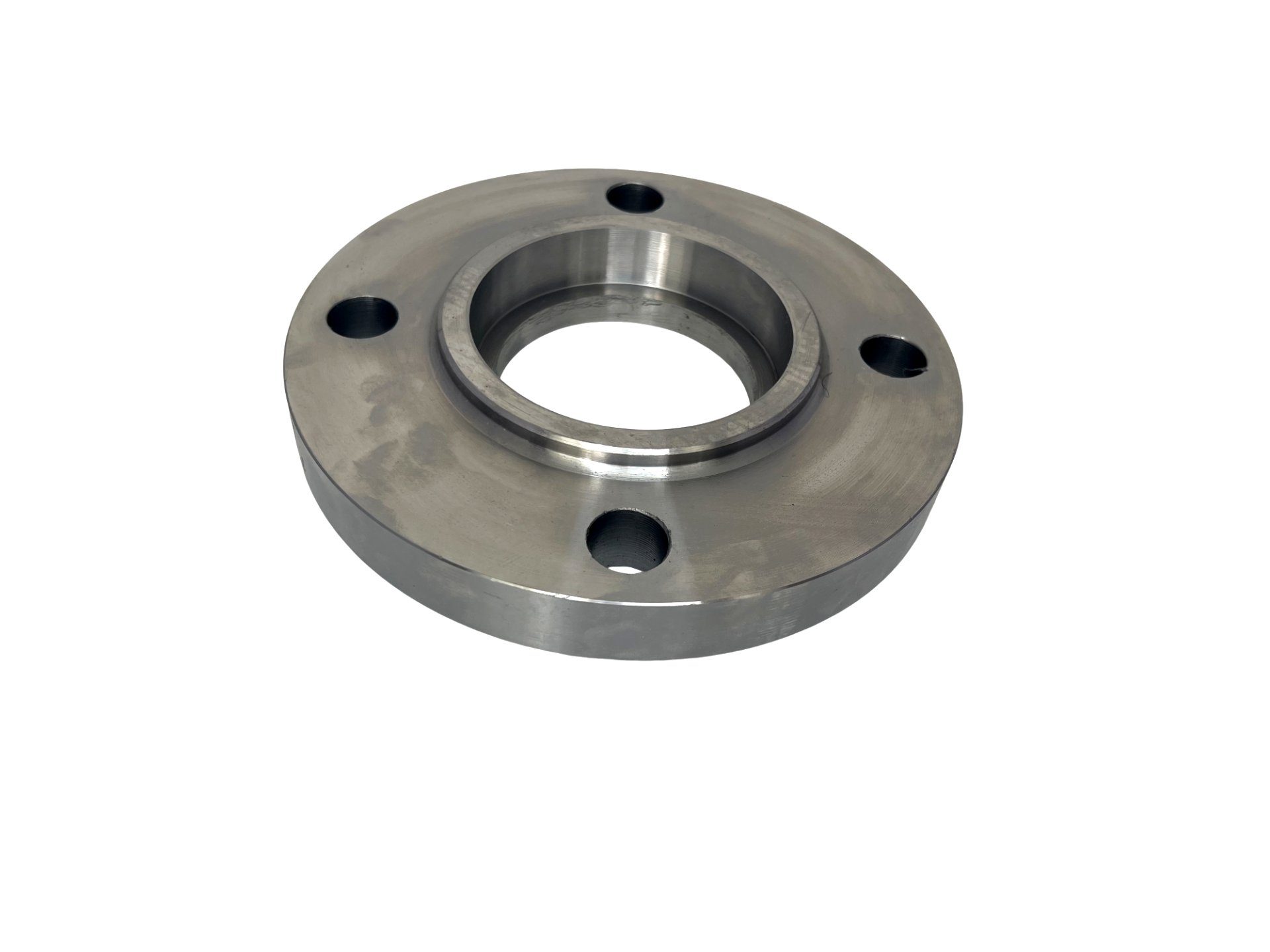
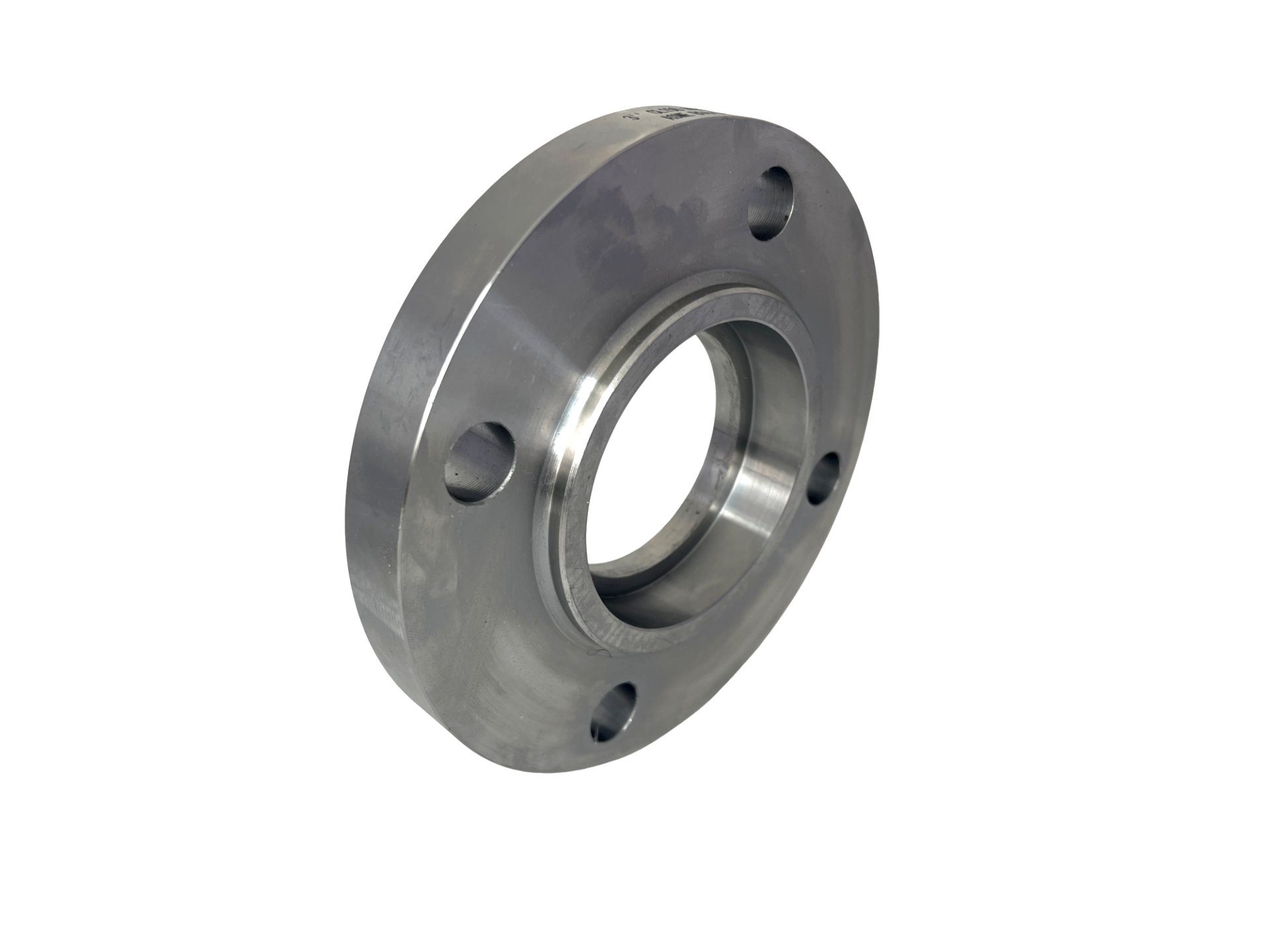
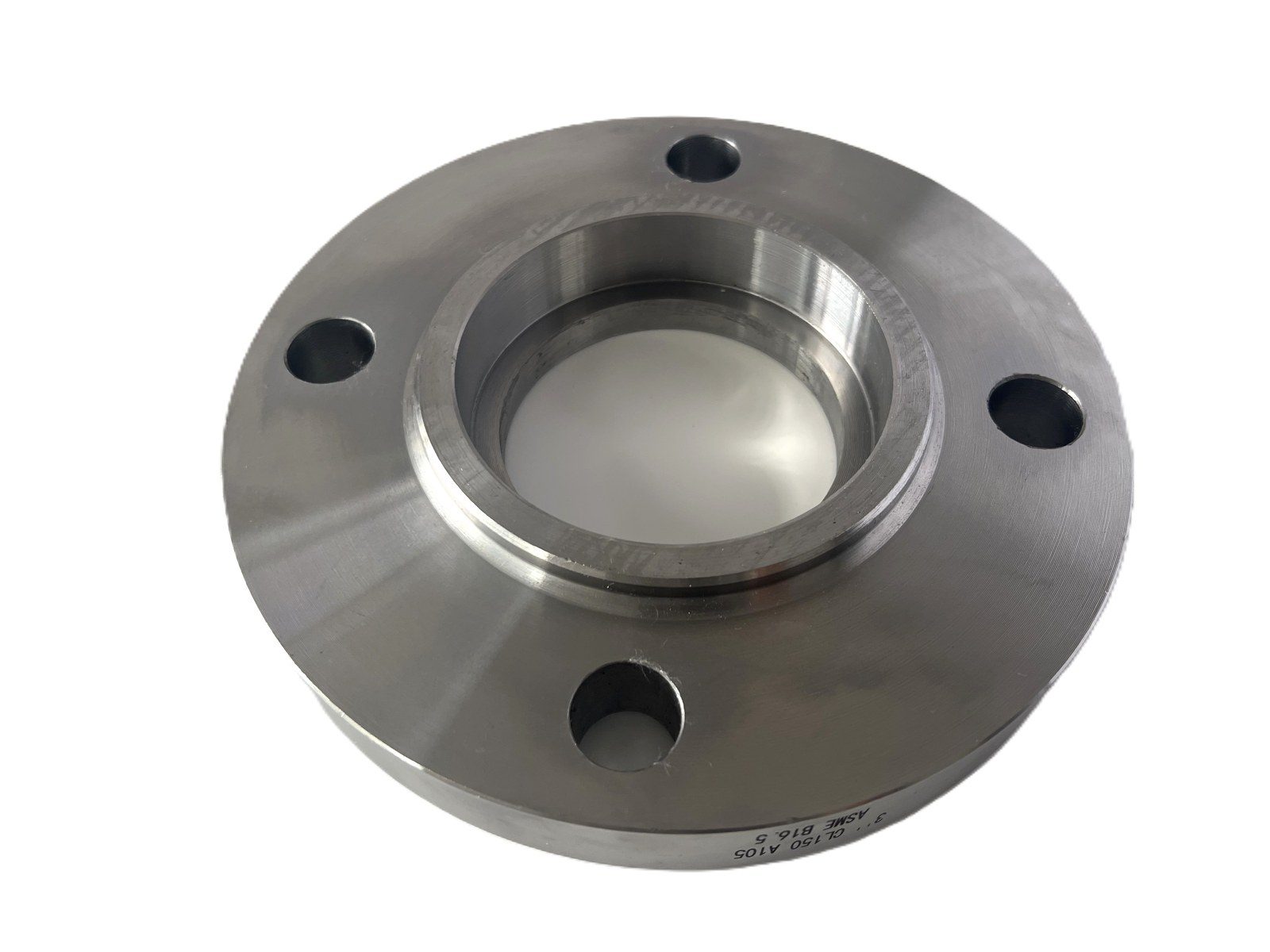
A socket weld flange has a counterbored socket machined into the bore. The pipe is inserted into the socket until it bottoms, then withdrawn approximately 1/16 inch (1.6 mm) to leave an expansion gap, and a single fillet weld is run around the outside of the hub. No weld is made inside the bore, so there is no weld bead, no slag, and no restriction in the flow path when the bore is machined correctly. Socket weld flanges are used on small-bore piping where a butt weld is not practical: instrument connections, sampling and chemical injection lines, steam tracing, utility headers, hydraulic lines, and high-pressure small-bore process connections in refineries and petrochemical plants. Because the joint relies on a fillet weld rather than full penetration, socket weld is restricted by many owner specifications for sour service, severe cyclic service, and fluids where crevice corrosion is a concern. We manufacture carbon steel socket weld flanges from our factory in Cangzhou, China's pipe-fitting industrial cluster, to ASME B16.5. Each shipment is accompanied by an EN 10204 3.1 Material Test Certificate.
Carbon Steel Socket Weld Flanges
Specifications
| Materials | ASTM A105 (carbon steel) |
| Standards | ASME B16.5 |
| Size Range | NPS 1/2 inch to 3 inch as standard; 4 inch and larger available on request |
| Pressure Class | Class 150 to Class 1500 per ASME B16.5. In practice, socket weld flanges are most commonly specified in Class 150 to Class 600 for small-bore service. Where a higher class is required, weld neck is normally the correct specification. |
| Flange Face Type | RF (Raised Face) — standard; FF (Flat Face) — on request. RTJ facing is not normally specified on socket weld flanges; where the piping class calls for RTJ, the service is generally high pressure or high temperature and weld neck is the correct choice. |
| Bore | The socket bore accepts the pipe outside diameter, and the through bore is machined to match the pipe inside diameter. Pipe schedule must be specified at quotation stage so the bore can be matched and no step is left at the joint. |
| Weld Type | Single fillet weld on the outside of the hub. The joint is not full penetration, and the socket leaves an annular crevice between the pipe outside diameter and the socket wall. |
| Expansion Gap | The pipe is bottomed in the socket and then withdrawn approximately 1/16 inch (1.6 mm) before welding, as required by ASME B31.3. This gap accommodates thermal expansion during welding and in service. |
| Manufacturing Process | Forged, machined to ASME B16.5 |
| Surface Treatment | Rust preventive oil + VCI film (standard for sea shipping); hot-dip galvanizing per ASTM A153; cold blackening; clear lacquer |
| MOQ | Negotiable based on specifications and destination port. Standard items can ship from a single pallet; custom orders typically require full container load. |
| Lead Time | Standard items ship within 7-15 days; custom orders and non-standard bore machining 20-35 days; shipping time additional depending on destination (typically 30-60 days sea voyage to Middle East ports) |
| HS Code | 7307.91 (carbon steel flanges); GCC Common External Tariff 5% on CIF value for Oman and UAE import |
| Customization | Non-standard sizes, bore machined to a specified pipe schedule, modified hub dimensions, and special marking are supported. Technical drawings or detailed specifications required for custom orders. |
| Documents | EN 10204 Type 3.1 MTC (standard with every shipment); impact test, hardness test, and NDT reports (MT / PT) on request at quotation stage |
Application Scenarios
Commonly supplied to the following industries and applications:
- Instrument and analyser connections, sampling points, and chemical injection quills
- Small-bore process connections in refineries and petrochemical plants, typically Class 300 to Class 600
- Steam tracing, condensate return, and utility headers
- Hydraulic and lubrication oil lines, where a leak-tight small-bore joint is required
- Instrument air, nitrogen, and plant air distribution
- Firewater ring main branch connections and deluge system small-bore takeoffs
- Skid-mounted and modular packages, where small-bore piping is assembled and pressure tested in the shop
- EPC contractors and overseas infrastructure projects — water transmission mains, district cooling networks, airport and industrial park piping, supplied to the project specification and the document package your QA team requires
Socket weld flanges are not intended for large-bore process lines, for severe cyclic service, or for sour service. For those duties, weld neck flanges are the correct specification.
Samples, Third-Party Inspection and Test Records
Sample pieces can be produced before the batch runs, so that dimensions, bevel profile and fit-up can be checked on your side first. Sample cost and delivery time are advised with the quotation, based on size and material.
Buyer-nominated inspection is supported. SGS, BV, Intertek or your own inspector can witness dimensional checking, marking, coating and container loading at the production site, and we provide the documents and site access needed for the visit. Where a visit is not practical, the same checks can be followed through a live video walkthrough. Third-party inspection fees are normally carried by the buyer.
Non-destructive testing and hydrostatic test records are available on request and can be shipped with the order, together with the EN 10204 3.1 material certificate, the heat number and marking list, dimensional records, packing list and certificate of origin. Tell us at enquiry stage which records your project requires, and they are included in the quotation.
Socket Weld vs Weld Neck
| Criterion | Socket Weld (SW) | Weld Neck (WN) |
|---|---|---|
| Joint Type | Fillet weld, pipe sits in a socket | Full penetration butt weld |
| Weld Location | One fillet weld on the outside of the hub | Full penetration groove weld at the hub end |
| Flow Path | Bore machined to pipe ID; no internal weld bead | Smooth continuous bore, no step |
| Crevice | Annular crevice between pipe OD and socket wall | No crevice |
| Size Range | NPS 1/2 inch to 3 inch | NPS 1/2 inch to 60 inch |
| Pressure Class | Class 150 - Class 1500; commonly 150 - 600 | Class 150 - Class 2500 |
| Fatigue Resistance | Lower; fillet weld is not full penetration | Highest of all flange types |
| Radiographic Examination | Not effective on a fillet weld; MT / PT used | RT, UT, MT, PT all applicable |
| Sour Service | Commonly restricted or prohibited | The standard specification |
| Pipe Schedule Required | Yes, for through bore matching | Yes, for flange bore |
| Field Fit-Up | No bevel, no alignment clamp; easy in tight spaces | Requires bevel, alignment, and a qualified welder |
| Typical Applications | Small bore, instrument, tracing, utility, hydraulic | Main process lines, high pressure, high temperature, |
| cyclic and sour service |
Selection Logic
Buyer FAQ
Q1: What sizes are socket weld flanges available in, and why only small bore?
A1: Socket weld flanges are supplied in NPS 1/2 inch to 3 inch as standard, with larger sizes available on request. The reason is the joint itself: a socket weld carries load through a single fillet weld around the outside of the hub. As the pipe size increases, the loads on that fillet weld increase faster than the weld can economically carry, so above roughly NPS 3 the butt weld of a weld neck flange is the correct and more economical joint. Socket weld is therefore a small-bore solution by design, not a limitation of supply. If your line is NPS 4 or larger, please ask us for a weld neck quotation.
Q2: Do I need to specify the pipe schedule for a socket weld flange?
A2: Yes. The socket bore accepts the pipe outside diameter, and the through bore is machined to match the pipe inside diameter. If the schedule is not given, the bore cannot be matched, and a step is left at the joint that restricts flow, creates turbulence, and gives a place for erosion and product build-up to start. Please state nominal pipe size, class, and pipe schedule at quotation stage. Where the line carries slurry, a two-phase fluid, or anything that can collect in a recess, the bore match matters more, not less.
Q3: What is the 1/16 inch expansion gap, and why does it matter?
A3: The pipe is inserted into the socket until it bottoms, then withdrawn approximately 1/16 inch (1.6 mm) before the fillet weld is run. ASME B31.3 requires this. The gap allows the pipe to expand during welding and in service so the pipe end is not driven into the bottom of the socket. If the pipe is left bottomed out, thermal expansion puts the weld and the socket shoulder under stress and can crack the joint. This is one of the most frequently missed details on site, and it cannot be checked after welding is complete. Please confirm that your welding procedure includes the gap.
Q4: Can socket weld flanges be used in sour service?
A4: In general no. Socket weld joints are commonly restricted or prohibited in sour service because the annular crevice between the pipe outside diameter and the socket wall cannot be fully welded or effectively examined, and that crevice is where sulphide stress cracking can initiate. Where the piping class specifies sour service to NACE MR0175 / ISO 15156, a weld neck flange with a full penetration butt weld is the standard specification. Please tell us if the service contains H2S and we will confirm the correct flange type rather than quote a socket weld by default.
Q5: Can socket weld flanges be used where the line is subject to vibration or thermal cycling?
A5: They are not the preferred choice. A socket weld is a fillet weld, not full penetration, and its fatigue resistance is lower than that of a butt weld. Under vibration, pump or compressor cycling, or repeated thermal cycles, the fillet weld is the usual location for a fatigue crack to start. For compressor discharge, reciprocating pump lines, and any line with significant temperature swing, specify weld neck. Socket weld is well suited to static small-bore lines that are installed and then left alone.
Q6: How is a socket weld joint examined? Can I get RT on it?
A6: Radiographic examination is not effective on a socket weld, because the joint is a fillet weld and the geometry makes the film difficult to interpret. Surface examination by MT (magnetic particle) or PT (liquid penetrant) is the normal method, and these are what we can arrange on request at quotation stage. If your specification requires volumetric examination of the joint, that requirement points to a full penetration butt weld, which means a weld neck flange. Please tell us the examination requirement at quotation stage so we can quote the correct joint and the correct documentation.
Q7: Is socket weld better than threaded for small bore?
A7: For most services, yes. A threaded joint is a mechanical connection that can loosen under vibration and thermal cycling, and the thread itself is a leak path and a place for corrosion to start. A socket weld has no threaded leak path and holds up better under cycling. The reason to choose threaded instead is different: when hot work is not permitted on site, when there is no qualified welder available, or when the line has to be broken and remade without cutting. Threaded is also generally limited to lower classes. If the line can be welded and will stay welded, socket weld is the better small-bore joint.
Q8: Can socket weld flanges be used on corrosive or seawater service?
A8: This needs care. The socket leaves an annular crevice between the pipe outside diameter and the socket wall, and crevice corrosion starts in exactly that kind of gap. In seawater, brine, and chloride-containing service, that crevice is a known problem. Many owner specifications prohibit socket weld on corrosive duties for this reason. Where a small-bore connection is needed on a corrosive line, tell us the fluid, concentration, and temperature, and we will confirm whether a socket weld is acceptable or whether the connection should be made another way.
Q9: Do I need any special installation instructions for the welder?
A9: Three points are worth putting in writing for the site. First, bottom the pipe in the socket and then withdraw it approximately 1/16 inch (1.6 mm) before welding, as required by ASME B31.3. Second, run the fillet weld around the outside of the hub only; no weld is made inside the bore and none should be attempted. Third, do not weld with the pipe bottomed out, and do not fill the gap with weld metal, because that defeats the purpose of the gap. We can provide a written installation note with the quotation if that is useful for your site team.
Q10: What is the HS Code and tariff for carbon steel socket weld flanges imported into Oman and the UAE?
A10: Carbon steel socket weld flanges are classified under HS Code 7307.91 (tube or pipe fittings of iron or steel — flanges of iron or steel, other than stainless). GCC Common External Tariff is 5% on CIF value for goods imported into Oman and the UAE. Standard import documentation includes Commercial Invoice, Packing List, Bill of Lading, Certificate of Origin (Form A or applicable FTA), MTC 3.1, and Fumigation Certificate for wooden packaging. Since 2026, electronic Bayan (e-Bayan) declaration is mandatory for Oman customs clearance; UAE importers file through Dubai Customs or the relevant emirate portal. We can provide full export documentation support per your request.
Q11: What sizes and pressure ratings are available for carbon steel socket weld flanges?
A11: NPS 1/2 inch to 3 inch as standard, with 4 inch and larger available on request. Class 150 to Class 1500 per ASME B16.5. Sizes and ratings outside this range can be reviewed against your drawing. The exact range confirmed for your order is stated in the quotation.
Q12: How is the wall thickness determined for carbon steel socket weld flanges?
A12: Flange dimensions, including hub and thickness, are fixed by the ASME standard for the size and pressure class you specify. They are not chosen separately. The matching pipe schedule is confirmed at quotation stage.
Q13: What is the lead time for carbon steel socket weld flanges?
A13: Standard sizes in regular material normally take 7-15 days. Non-standard sizes, special materials and custom orders take longer. The exact lead time for this product is given in the specification table on this page and is confirmed in writing with your quotation. Sea freight to the Gulf is additional and depends on the destination port. All lead times are subject to the production schedule at the time of order.
Q14: Is there a minimum order quantity for carbon steel socket weld flanges?
A14: There is no fixed minimum. Standard items can ship from a single pallet, and custom production is normally quoted at full container load. Small trial orders and mixed-size orders are accepted. Send your size list and we will confirm what can be combined in one shipment.
Q15: How are carbon steel socket weld flanges packed and marked?
A15: Flanges and fittings are packed in plywood cases or on plywood pallets with anti-rust treatment, strapped and stretch-wrapped for sea freight. Each piece carries the heat number, and the material, size, standard and pressure class or schedule are marked on the item or on the case label. Shipping marks are printed to your specification, and a fumigation certificate is provided where wooden packaging is used.
Q16: Can you produce carbon steel socket weld flanges to our drawing or to non-standard specifications?
A16: Yes. Send the drawing, material, quantity and the applicable standard, and we will confirm feasibility and quote. Non-standard angles, non-standard schedules, special materials and special dimensions are produced against your drawing. The details we need to quote are listed on our custom service page. The details we need to quote are listed on our custom service page.
Engineer's Note
The following technical guidance reflects the perspective of a senior piping engineer with extensive experience in industrial piping system design.
A socket weld flange solves a specific problem: it gives a welded, leak-tight joint on small-bore pipe without the bevel preparation, alignment, and fit-up work of a butt weld. It is not a general substitute for weld neck, and it should be specified for its own strengths. The following factors should drive your specification:
- Socket Weld Is a Small-Bore Solution
- Standard range is NPS 1/2 inch to 3 inch, because the joint carries load through a single fillet weld
- Above roughly NPS 3, a full penetration butt weld is the correct and more economical joint
- Do not extend socket weld into large bore for convenience of fit-up; the joint is not the same thing
- The Expansion Gap Is Not Optional
- Bottom the pipe, then withdraw approximately 1/16 inch (1.6 mm) before welding, per ASME B31.3
- The gap accommodates thermal expansion during welding and in service
- A bottomed-out pipe puts the weld and socket shoulder under stress and can crack the joint
- This cannot be verified after welding; it has to be in the welding procedure
- The Crevice Is the Real Weakness
- An annular gap remains between the pipe outside diameter and the socket wall
- That crevice is where crevice corrosion and sulphide stress cracking initiate
- Socket weld is commonly restricted for corrosive service, seawater, brine, and sour service
- Where the fluid attacks crevices, a full penetration butt weld is the correct answer
- Fatigue Resistance Is Lower Than a Butt Weld
- A fillet weld is not full penetration and has lower fatigue strength
- Vibration, pump and compressor cycling, and thermal cycling are the common failure drivers
- For cyclic duty, use weld neck
- Examination Is Limited
- RT is not effective on a fillet weld because of the joint geometry
- MT and PT are the normal examination methods
- If the specification requires volumetric examination, that requirement points to weld neck
- Pipe Schedule Still Matters
- The socket accepts the pipe outside diameter; the through bore matches the pipe inside diameter
- A bore mismatch leaves a step at the joint: turbulence, erosion, and product build-up
- Always state nominal size, class, and schedule
- Where Socket Weld Is the Right Answer
- Small bore, static, non-corrosive, non-cyclic service
- Instrument and analyser connections, sampling points, chemical injection quills
- Steam tracing, condensate, utility headers, instrument air and nitrogen
- Hydraulic and lubrication oil lines
- Skid and modular packages assembled and tested in the shop
- Common Mistakes to Avoid
- Welding with the pipe bottomed out, with no expansion gap
- Filling the gap with weld metal and defeating its purpose
- Extending socket weld into large bore or main process lines
- Specifying socket weld on sour, corrosive, seawater, or severe cyclic service
- Expecting RT to give a meaningful result on a fillet weld
- Ordering without the pipe schedule, then receiving a bore that does not match
For project-specific engineering support, please share your service conditions (size, class, design pressure and temperature, fluid composition, pipe schedule, H2S content, cyclic duty, and examination requirements) and we will review the specification and provide a written recommendation.
Frequently Asked Questions
What sizes are socket weld flanges available in, and why only small bore?
Socket weld flanges are supplied in NPS 1/2 inch to 3 inch as standard, with larger sizes available on request. The reason is the joint itself: a socket weld carries load through a single fillet weld around the outside of the hub. As the pipe size increases, the loads on that fillet weld increase faster than the weld can economically carry, so above roughly NPS 3 the butt weld of a weld neck flange is the correct and more economical joint. Socket weld is therefore a small-bore solution by design, not a limitation of supply. If your line is NPS 4 or larger, please ask us for a weld neck quotation.
Do I need to specify the pipe schedule for a socket weld flange?
Yes. The socket bore accepts the pipe outside diameter, and the through bore is machined to match the pipe inside diameter. If the schedule is not given, the bore cannot be matched, and a step is left at the joint that restricts flow, creates turbulence, and gives a place for erosion and product build-up to start. Please state nominal pipe size, class, and pipe schedule at quotation stage. Where the line carries slurry, a two-phase fluid, or anything that can collect in a recess, the bore match matters more, not less.
What is the 1/16 inch expansion gap, and why does it matter?
The pipe is inserted into the socket until it bottoms, then withdrawn approximately 1/16 inch (1.6 mm) before the fillet weld is run. ASME B31.3 requires this. The gap allows the pipe to expand during welding and in service so the pipe end is not driven into the bottom of the socket. If the pipe is left bottomed out, thermal expansion puts the weld and the socket shoulder under stress and can crack the joint. This is one of the most frequently missed details on site, and it cannot be checked after welding is complete. Please confirm that your welding procedure includes the gap.
Can socket weld flanges be used in sour service?
In general no. Socket weld joints are commonly restricted or prohibited in sour service because the annular crevice between the pipe outside diameter and the socket wall cannot be fully welded or effectively examined, and that crevice is where sulphide stress cracking can initiate. Where the piping class specifies sour service to NACE MR0175 / ISO 15156, a weld neck flange with a full penetration butt weld is the standard specification. Please tell us if the service contains H2S and we will confirm the correct flange type rather than quote a socket weld by default.
Can socket weld flanges be used where the line is subject to vibration or thermal cycling?
They are not the preferred choice. A socket weld is a fillet weld, not full penetration, and its fatigue resistance is lower than that of a butt weld. Under vibration, pump or compressor cycling, or repeated thermal cycles, the fillet weld is the usual location for a fatigue crack to start. For compressor discharge, reciprocating pump lines, and any line with significant temperature swing, specify weld neck. Socket weld is well suited to static small-bore lines that are installed and then left alone.
How is a socket weld joint examined? Can I get RT on it?
Radiographic examination is not effective on a socket weld, because the joint is a fillet weld and the geometry makes the film difficult to interpret. Surface examination by MT (magnetic particle) or PT (liquid penetrant) is the normal method, and these are what we can arrange on request at quotation stage. If your specification requires volumetric examination of the joint, that requirement points to a full penetration butt weld, which means a weld neck flange. Please tell us the examination requirement at quotation stage so we can quote the correct joint and the correct documentation.
Is socket weld better than threaded for small bore?
For most services, yes. A threaded joint is a mechanical connection that can loosen under vibration and thermal cycling, and the thread itself is a leak path and a place for corrosion to start. A socket weld has no threaded leak path and holds up better under cycling. The reason to choose threaded instead is different: when hot work is not permitted on site, when there is no qualified welder available, or when the line has to be broken and remade without cutting. Threaded is also generally limited to lower classes. If the line can be welded and will stay welded, socket weld is the better small-bore joint.
Can socket weld flanges be used on corrosive or seawater service?
This needs care. The socket leaves an annular crevice between the pipe outside diameter and the socket wall, and crevice corrosion starts in exactly that kind of gap. In seawater, brine, and chloride-containing service, that crevice is a known problem. Many owner specifications prohibit socket weld on corrosive duties for this reason. Where a small-bore connection is needed on a corrosive line, tell us the fluid, concentration, and temperature, and we will confirm whether a socket weld is acceptable or whether the connection should be made another way.
Do I need any special installation instructions for the welder?
Three points are worth putting in writing for the site. First, bottom the pipe in the socket and then withdraw it approximately 1/16 inch (1.6 mm) before welding, as required by ASME B31.3. Second, run the fillet weld around the outside of the hub only; no weld is made inside the bore and none should be attempted. Third, do not weld with the pipe bottomed out, and do not fill the gap with weld metal, because that defeats the purpose of the gap. We can provide a written installation note with the quotation if that is useful for your site team.
What is the HS Code and tariff for carbon steel socket weld flanges imported into Oman and the UAE?
Carbon steel socket weld flanges are classified under HS Code 7307.91 (tube or pipe fittings of iron or steel — flanges of iron or steel, other than stainless). GCC Common External Tariff is 5% on CIF value for goods imported into Oman and the UAE. Standard import documentation includes Commercial Invoice, Packing List, Bill of Lading, Certificate of Origin (Form A or applicable FTA), MTC 3.1, and Fumigation Certificate for wooden packaging. Since 2026, electronic Bayan (e-Bayan) declaration is mandatory for Oman customs clearance; UAE importers file through Dubai Customs or the relevant emirate portal. We can provide full export documentation support per your request.
What sizes and pressure ratings are available for carbon steel socket weld flanges?
NPS 1/2 inch to 3 inch as standard, with 4 inch and larger available on request. Class 150 to Class 1500 per ASME B16.5. Sizes and ratings outside this range can be reviewed against your drawing. The exact range confirmed for your order is stated in the quotation.
How is the wall thickness determined for carbon steel socket weld flanges?
Flange dimensions, including hub and thickness, are fixed by the ASME standard for the size and pressure class you specify. They are not chosen separately. The matching pipe schedule is confirmed at quotation stage.
What is the lead time for carbon steel socket weld flanges?
Standard sizes in regular material normally take 7-15 days. Non-standard sizes, special materials and custom orders take longer. The exact lead time for this product is given in the specification table on this page and is confirmed in writing with your quotation. Sea freight to the Gulf is additional and depends on the destination port. All lead times are subject to the production schedule at the time of order.
Is there a minimum order quantity for carbon steel socket weld flanges?
There is no fixed minimum. Standard items can ship from a single pallet, and custom production is normally quoted at full container load. Small trial orders and mixed-size orders are accepted. Send your size list and we will confirm what can be combined in one shipment.
How are carbon steel socket weld flanges packed and marked?
Flanges and fittings are packed in plywood cases or on plywood pallets with anti-rust treatment, strapped and stretch-wrapped for sea freight. Each piece carries the heat number, and the material, size, standard and pressure class or schedule are marked on the item or on the case label. Shipping marks are printed to your specification, and a fumigation certificate is provided where wooden packaging is used.
Can you produce carbon steel socket weld flanges to our drawing or to non-standard specifications?
Yes. Send the drawing, material, quantity and the applicable standard, and we will confirm feasibility and quote. Non-standard angles, non-standard schedules, special materials and special dimensions are produced against your drawing. The details we need to quote are listed on our custom service page.
Related products
- carbon steel threaded flanges
- carbon steel weld neck flanges
- carbon steel slip-on flanges
- EN 10204 3.1 material certificate