
The face is the part of a flange that seals. The hub, the bolt circle and the bore are there to bring two faces together and hold them under stud load, and if the face is wrong the joint either will not assemble or will not hold its first pressure test.
Almost every enquiry that reaches a Gulf stockist is one of three face types: raised face, flat face or ring type joint. They are not interchangeable, and drawings that arrive with an enquiry name the wrong one often enough that the face is worth confirming before anything else on the sheet is read.
Raised face: 1.6 mm for Class 150 and 300, 6.4 mm for Class 400 and above
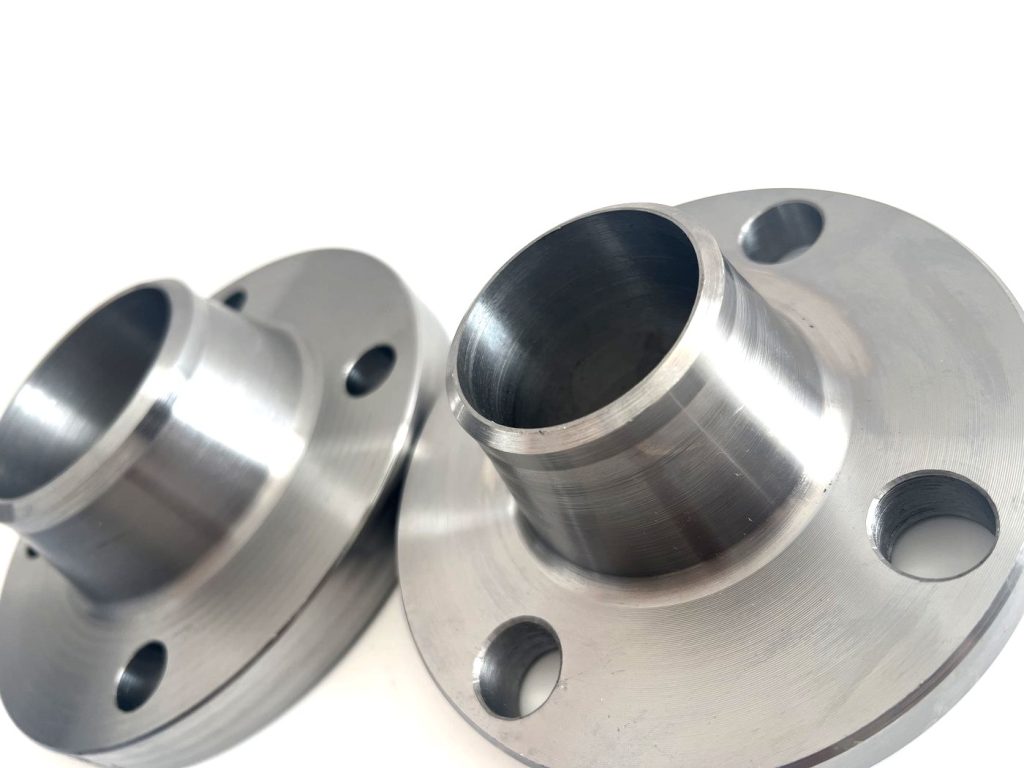
A raised face flange has a machined boss standing above the bolting plane, and the gasket sits on that boss. Because the stud load is applied to a smaller area than a flat plate would give, RF holds pressure in services where a flat face of the same thickness would not.
The height of the boss follows the class rather than the size. ASME B16.5 puts it at 1.6 mm, one sixteenth of an inch, on Class 150 and Class 300, and at 6.4 mm, one quarter of an inch, from Class 400 upward. A 4 inch Class 300 and a 4 inch Class 600 are both described as RF, and their faces stand 4.8 mm apart.
The class moves the bolt pattern at the same time, and in practice that is what catches a wrong pick before it becomes a wrong joint. At 4 inch, Class 300 sits on a 200 mm bolt circle, drilled 7/8 inch for 3/4 inch studs; Class 600 sits on 215.9 mm, drilled 1 inch for 7/8 inch studs. The studs will not go through. A mixed pair is found at the hole, which is the cheap place to find it.
The expensive version is on the drawing, where a take-off steps from Class 300 to Class 600 and carries its stud length across. Stud length is set by flange thickness, face height, gasket thickness and nut allowance, and the first two both change with the class. The order arrives correct in every column except the one that matters.
Where catalogues quote two different numbers
The dimensions that cause arguments on a comparison sheet are flange thickness and length through hub, measured from the gasket face to the weld end. On Class 150 and 300 the 1.6 mm face is inside both numbers. From Class 400 up the 6.4 mm sits outside them.
That is a convention rather than an error, and it is the one most catalogues follow. Two charts of the same 4 inch flange can differ by roughly 6 mm at the same nominal size and both be right against the drawing they were copied from, which is why a table assembled from two suppliers needs a basis line.
On a purchase order it is one line: state whether the raised face is included. Without it, a stockist comparing two quotations reads the shorter dimension as the undersized one and buys against the wrong column.
Flat face: the pairing rule that gets skipped
A flat face flange has no boss. The gasket surface is in the same plane as the bolting face, and the gasket is a full ring, bored for the pipe and drilled for the studs.
FF is used where the mating part cannot take a point load at the boss. A cast iron flange pulled down against a raised face is bent across the gap, and cast iron cracks rather than bends. ASME B31.1 states the fix directly: where a flat face cast iron flange meets a carbon steel flange, the raised face on the steel side is machined off and a full face gasket is used.
Bolting an FF to an RF as supplied is the mistake to avoid. The faces touch at the boss alone, the outer part of the full face gasket is never loaded, and a joint designed as a face contact becomes a narrow ring that the studs cannot keep tight once the line is at temperature.
Ring type joint: the groove seals, not the face
An RTJ flange carries a machined groove, usually cut into a raised face, and a metal ring sits in it. The studs drive the ring into the groove, the ring yields against the groove walls, and the seal is metal to metal. There is no sheet gasket to compress and nothing to take a set; the raised face around the groove does no sealing work at all.
That is why RTJ appears on Class 600 and above, and on lines above roughly 427 °C (800 °F) where a spiral wound gasket would relax. The ring is a machined part with its own standard, ASME B16.20, and its own hardness rule: it has to be softer than the groove, or it damages the flange it was bought to seal.
Rings are ordered by R number. At 3 inch, Class 150 takes R-29, Class 300 through 900 take R-31, and Class 1500 takes R-35. An enquiry that says “3 inch RTJ gasket” leaves the supplier to choose between three rings, and the choice is a guess.
Oval and octagonal rings are different parts that seat in the same groove. Octagonal is what most mills ship now; oval is the older profile and still appears on drawings that were never revised. Both are covered by B16.20 and both are checked against the same groove dimensions.
One size at three ratings
The quickest way to see what a class moves is one size at three ratings.
| 4″ B16.5 | Class 150 | Class 300 | Class 600 |
|---|---|---|---|
| Outside diameter | 228.6 mm (9.00″) | 254.0 mm (10.00″) | 273.1 mm (10.75″) |
| Bolt circle | 190.5 mm (7.50″) | 200.0 mm (7.88″) | 215.9 mm (8.50″) |
| Holes | 8 × 19.1 mm (3/4″) | 8 × 22.2 mm (7/8″) | 8 × 25.4 mm (1″) |
| Stud | 5/8″ | 3/4″ | 7/8″ |
| Raised face height | 1.6 mm | 1.6 mm | 6.4 mm |
Eight holes at all three ratings, on three bolt circles, in three stud sizes, and the face height changes at Class 600. An order that says “4 inch RF” and stops there leaves the supplier to pick the rest.
What the purchase order has to carry
- Face type plus class, not face type alone. “RF 150/300” and “RF 600+” are two different parts with the same name.
- The basis for flange thickness and length through hub: raised face included or excluded.
- For RTJ, the R number and the ring profile. Size and class alone will be read wrong at least once.
B16.5 runs to 24 inch. From 26 inch the reference is B16.47, series A or series B, and those two series are not interchangeable either. A quotation that offers 30 inch against a B16.5 drawing has changed the standard without saying so.
Getting the face right costs one line on the enquiry. Getting it wrong costs a set of studs cut to the wrong length, or a pallet of gaskets that fit nothing on site, and neither is discovered until the goods are unpacked.
Mingyang Pipe Fittings Co., Ltd. supplies carbon steel flanges to ASME B16.5 in raised face, flat face and ring joint, Class 150 and 300 as standard with higher ratings quoted per order, from Cangzhou, China, with mill test certificates to EN 10204 3.1. Send the face type, the class and the R number if it is RTJ, and we will check them against the drawing before the order is priced. mingyangpiping.com